


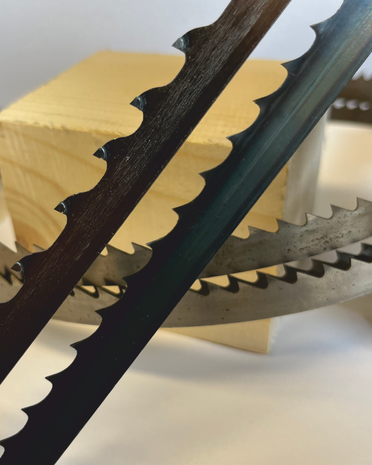
Band saw blades for wood: hardened, unhardened and carbide teeth. What is the difference?
16
Full article
Our range of blades also includes several types that can be used for carpentry band saws, or are even designed directly for them. We describe what characterises them, which properties are most important and what options you can choose from. But first a few words about carpentry band saws themselves.
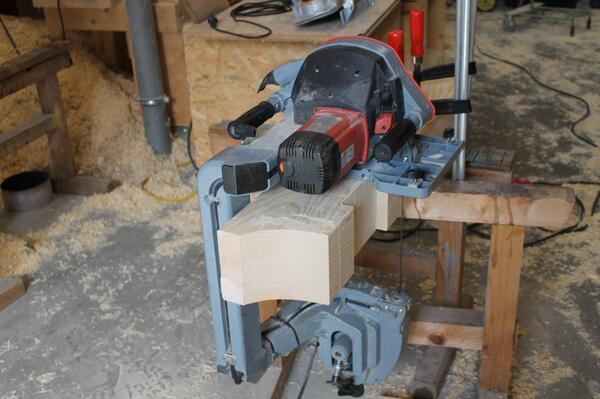
A special carpentry band saw operates in such a way that during cutting the operator manipulates the machine – moving it along the beam and cutting the required shape into it. This is probably the most striking difference compared to a conventional joiner’s band saw, which stands fixed and motionless while the operator manipulates the workpiece.
These band saws are most often used for contour cutting – for example for cutting birdsmouths, rafter ends, beam heads in timbered buildings or various types of carpentry beam joints. On the market you will find several brands, for example Protool, Mikeska and above all Mafell, probably the best-known machine.
In the case of the band saw blade it does not really matter whether the operator moves the machine or the workpiece. For carpentry band saws you can therefore use standard wood-cutting blades of the Flexback type (more about the Flexback range here).
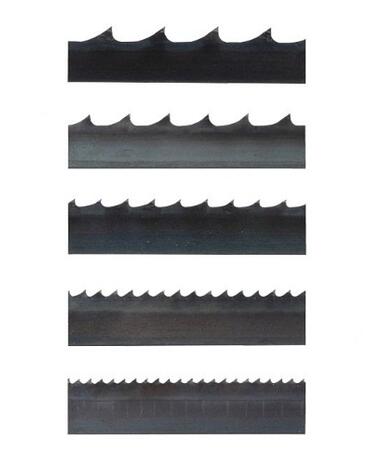
What is important to bear in mind? In this case the band saw blade must be sufficiently narrow so that you can cut a radius with it (for a 25 mm radius, a width of 8 mm works best; for a smaller radius, a width of 6 mm is fine). You will most likely want a smooth cut – this can be achieved, but at the expense of cutting speed. For beams up to 200 mm wide, the optimum tooth pitch is 4 TPI (i.e. 4 teeth per inch), or a finer 6 TPI pitch. For wider beams it is worth trying 3 TPI, but this pitch is only available on blades from 10 mm in width.
For some types of carpentry band saws (they must have rear carbide guides, for example the Mafell saw) you can use a special double-edged Flexback DE blade, which was developed specifically for this particular method of cutting. If you are interested in this blade, please contact us; it is not available in the e-shop.
The double-edged blade has cutting teeth with a 4 TPI pitch on the front side and on the rear side has ejection teeth (so-called back toothing), which remove chips from the cut – thanks to this, the resulting groove is cleaner and freer and the blade does not jam or even come off the wheel. (When cutting, it is often necessary to run the band saw blade into the beam, stop the machine and then return back out through the cut groove, which is much easier with a double-edged blade). This blade will certainly be appreciated, for example, by those of you who cut larch.
The choice of band saw blade must, of course, be adapted to your machine and to the cut you need to achieve. After discussions with several customers we bring you a few tips; you can also contact our technical advisors with your questions (contact).
Carpentry band saws Protool SBP 285 and Mikeska RPP290 – blade Flexback 1710x8x0,65 TPI 4 Hook
Carpentry band saw Mafell Z 5 Ec – blade Flexback 1750x8x0,65 TPI 4 Hook
blade Flexback DE 1750x8x0.65 TPI 4/14 (double-edged, order by e-mail)
What are your experiences with carpentry band saws? Which band saw blades have worked best for you? Share your observations with others in the comments under the article.

Good day, thank you for your message and your loyalty to our saws. The Flexback 1400×3×0.65 mm, 14 TPI band is still on offer – we have definitely not discontinued its production. However, it is true that when we do not have it in stock temporarily, we automatically hide it from the e-shop to avoid mistakes when ordering. The band is currently available again. If you wish, you can order it here: Flexback 1400x3x0.65 mm 14TPI saw blade
Sincerely, the Simonds team