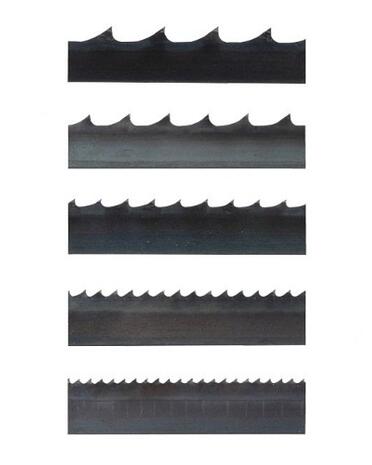
How to choose a bandsaw blade for wood
40
Full article
The right bandsaw blade width depends on the tightest curve you need to cut: a 6 mm blade handles a radius down to 15 mm, a 13 mm blade down to 65 mm. For straight cuts, use the widest blade your saw can tension properly. Blade thickness is determined by the diameter of the saw's wheels. We show it all in the video too.
A bandsaw blade has three dimensions: length, width and thickness. The length depends on your saw – the article How to determine the length of a band saw blade shows how to find it. Here we look at width and thickness. Both are listed for all our bandsaw blades for wood, which come in widths from 3 to 38 mm.
6 mm
Width by tightest curve
Take the widest blade that will still cut your tightest curve. A 6 mm blade manages a 15 mm radius.
13 mm
What your saw can take
Your saw's manual gives the maximum width. Small saws can only tension blades up to 13 mm properly.
0.65 mm
Thickness by wheel size
The smaller the wheels, the thinner the blade. Saws with 280–450 mm wheels take 0.65 mm.
In the video below, we show how blade width changes the curve you can cut and why a blade that is too thick breaks on small wheels. For the full step-by-step blade selection (thickness, width, tooth pitch, tooth shape), see the article How to choose a bandsaw blade for wood.


Width
Width is measured from the tip of the tooth to the back edge of the blade. The narrower the blade, the tighter the curve it can cut. The wider it is, the straighter it cuts and the longer it lasts.
In a long or deep cut, a narrow blade flexes more easily and wanders off to the side. For straight cuts and ripping boards, use the widest blade your saw can tension properly.
Make relief cuts first: several straight cuts from the edge of the workpiece up to the marked line. As you cut the curve, the waste drops away piece by piece and the blade doesn't bind in the cut.
The colour shows what each width is good for. The bar shows the blade width and the ring the smallest circle you can cut with it. Both are drawn in proportion, not to actual size.
These figures are a guide only; they vary by about 15% between manufacturers.

Thickness
Blade thickness (sometimes called gauge) is the thickness of the steel strip the blade is made from. With every revolution, the blade bends around the wheels and straightens out again. The smaller the wheels and the thicker the blade, the greater the stress and the sooner the blade breaks.
These figures apply to ordinary two-wheel woodworking bandsaws. Your saw's manual has the final say: some saws with wheels of around 300 mm only allow 0.5 mm. As an upper limit, you can work out wheel diameter ÷ 500 – a thicker blade will soon break on the wheels.
If 0.65 mm blades keep breaking on your small saw, try 0.5 mm. A thinner blade bends around the wheels more easily and lasts longer; it is just slightly less stiff. Three-wheel bandsaws have smaller wheels and the blade bends three times per revolution, so use blades 0.5 mm thick or thinner on them. Release the blade tension after work. You will find other causes in the article Why do bandsaw blades for wood break.
Blade size
| Size | Best for |
|---|---|
| 6 × 0.65 mm | cutting curves and shapes on most workshop bandsaws |
| 10 × 0.65 mm | gentle curves and straight cuts |
| 13 × 0.65 mm | straight cuts on small and mid-size saws |
| 8 × 0.65 mm | curves from 25 mm radius when 6 mm is too narrow |
The saw takes a 1,400 mm blade, 3–13 mm wide and 0.5 or 0.65 mm thick. For cutting curves, choose 6 mm; for straight cuts, 10–13 mm. You will find recommended blades in the article PARKSIDE wood bandsaw from Lidl.
A circle of about 80 mm in diameter (40 mm radius). For smaller circles, use a 6 mm blade, which cuts a radius down to 15 mm.
Usually yes: 12 mm in a manual normally means half an inch, i.e. 12.7 mm, which corresponds to our 13 mm blade. Just check that the blade is not wider than the wheel and that the saw can tension it properly.
You can, but in a long or deep cut a narrow blade flexes and wanders more easily. If you mostly cut straight, choose a 10–13 mm blade. A 6 mm blade is mainly for curves.

Good day, Mr. Stranava, thank you for your inquiry.
For a saw with a wheel diameter of 335 mm and cutting wood with a thickness of approximately 120 mm, we recommend a carbon steel band with hardened teeth, preferably the Flexback type, which is most common for wood. The band thickness should be 0.65 mm, which is ideal for 335 mm wheels and at the same time ensures good durability without premature cracking. If the machine allows for a wider band, a width of 16 – 20 mm with a 3 TPI Hook tooth is recommended, which allows for a fast and "draggy" straight cut. For a smoother surface, 4 TPI Hook can be used. Before selecting, it is advisable to check the maximum permissible band width in the machine's manual. The optimal band speed for cutting wood is 700 – 900 m/min, with the higher value (around 900 m/min) being suitable for softwood and a slightly lower value for hardwood. Regarding band tension, for carbon steel bands, a tension in the range of 120 – 140 N/mm² is appropriate. For a 16 × 0.65 mm band, this corresponds to a force of approximately 125 – 150 kg.
If you are interested in how to properly tension the band even without measuring, you can find a practical guide in our article: How to tension a wood saw blade
Regards, The Simonds Team
Thank you for your inquiry! With a 10mm wide saw band, you can cut approximately a circle with a diameter of about 80mm.
This is a guideline – in practice, it may vary slightly depending on the machine, wood type, and tooth pitch. Therefore, we recommend trying it out first.
If you want to cut smaller shapes or tighter radii, we recommend a narrower band width – for example, 6mm.
From our products, for example: Flexback 2320x6x0.65 mm
This band is very suitable for fine curved cuts while also providing good stability.
If you have any further questions, please write to us – we will be happy to advise you!
Sincerely, The Dudr Saw Team
Hello, yes, CARBIDE WOOD will be the most suitable for a quality cut. This blade is suitable for your band saw. Best regards, the Dudr team.
Hello, thank you for your inquiry. For the Proma PP-254, you should use a 0.5 mm thick blade due to the small wheels, but customers prefer a 0.65 mm thickness because the blade is stiffer and bends less. For daily cutting and breaking of 0.65 mm thick blades due to the bending of small wheels, we recommend trying 0.5 mm thick blades. For a cutting height of 60 mm, I recommend the Flexback 1825x13x0.65 TPI 4 - Hook for straight cuts. For carving, I recommend the Flexback 1825x6x0.65 TPI 4 - Skip.
Good luck, regards Pavel Dudr
Good day, Mr. Červený, we recommend loosening the saw blade on the saw a bit after work, especially if the machine is not used for a long time – this will extend its life. If blades with a thickness of 0.65 mm are breaking, try a thinner 0.50 mm one, we also recommend it to other customers and often the problem is solved this way. For example, here: Flexback 1440 x 6 x 0.5 mm. Unfortunately, we do not sell rubber rings, try to obtain spare parts directly from the saw manufacturer. Regards, the SIMONDS team
Good day, it is an inexpensive hobby saw, so not everything is perfect, it is not for productive cutting...
Try reading the tips, for example, when the blade cuts crookedly in this article here.
If you have a blade with a tooth thickness of only 0.36 mm, try a thicker one - our customers most prefer 1400x6x0.5 tpi 4 Skip and 1400x6x0.5 tpi 6 Skip
or a wider blade 1400x10x0.5 tpi 4 Skip and 1400x10x0.5 tpi 6 Skip.
Sincerely, Pavel Dudr
Good day, it depends on what kind of wood it is, but primarily on the cut, i.e. how high the wood is that the band will be passing through.
Generally, however, epoxy can be treated like very hard wood, so you can refer to this guide < / a>
However, I think that our CarbideWood would also work quite well for this, and its teeth are not as important.
S. Kolařík | kolarik@simonds.cz
Good day, the length of the saw blade for the Parkside PBS 350 C3 bandsaw is 1400 mm and you can use a blade width in the range of 3–13 mm. For this model, we offer the same saw blades as for the Parkside PBS 350 B2, but we have also added the C3 bandsaw to our search engine for saw blades by machine for clarity here: PBS 350 C3 – saw blade finder. If you know the length of 1400 mm, you can use the configurator for all types of saw blades: Configurator – length 1400 mm or choose from the catalog of blades that our customers have already ordered from us: Saw blades 1400 mm – catalog
For orientation: narrower blades (e.g. 6 mm) are suitable for shaped and curved cuts, wider blades (10–13 mm) are suitable for straight cuts and more precise guidance.
Thank you for your inquiry and have a nice day. Sincerely, the Simonds.cz team
Good morning, the guides should press on the band, they should be about 3 mm below the running wheels. Check if the guides are keeping the band horizontal. Then the only possibility is that the carriage is faulty.
Thank you, good luck, regards
Pavel Dudr