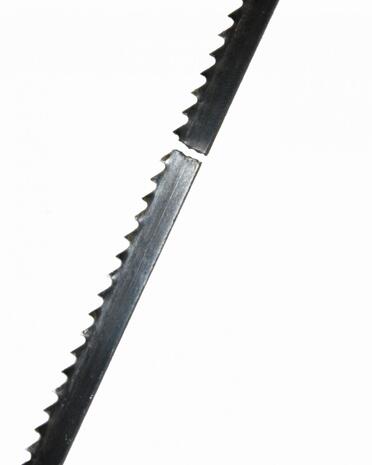
Why do bandsaw blades for wood break? We know the answers
18
Full article
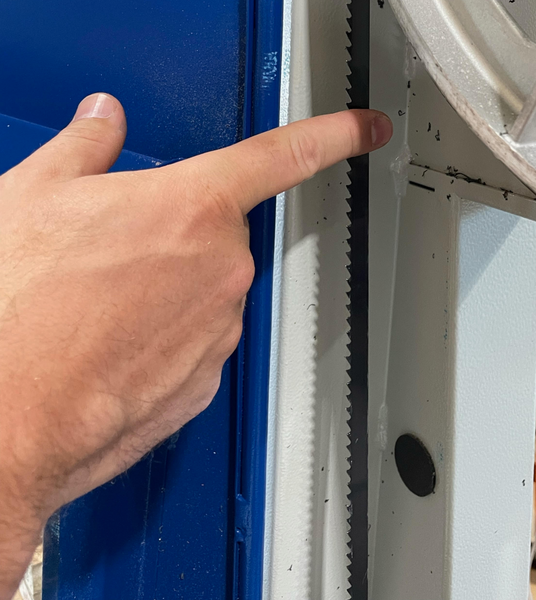
A bandsaw blade for wood is correctly tensioned when, on the free side of the saw, it deflects no more than 3 mm sideways under finger pressure and gives a metallic ring when tapped. Before you tension it, set it on the upper wheel so that the gullet sits in the centre of the wheel. Release the tension again after work. The full procedure is below, step by step.
The tensioner on the saw (a handwheel or lever) moves the wheels apart and so tensions the blade. You can tell how much is right even without a gauge:
Under-tensioned
Correctly tensioned
Over-tensioned
Treat the tension scale on the saw as a rough guide only. On smaller saws it often reads higher than the real tension in the blade, and the tension spring weakens over time. Without a tension meter, the finger test and the sound decide.
Steps 1 and 2
Switch off the saw, unplug it, open the covers and back off the side guides and the rear bearings. The guides are set last, once the blade is tensioned and sits in its place.
When fitting the blade, check the direction of the teeth: on the table side they must point down, towards the table. If they point up, put on gloves and turn the blade inside out.
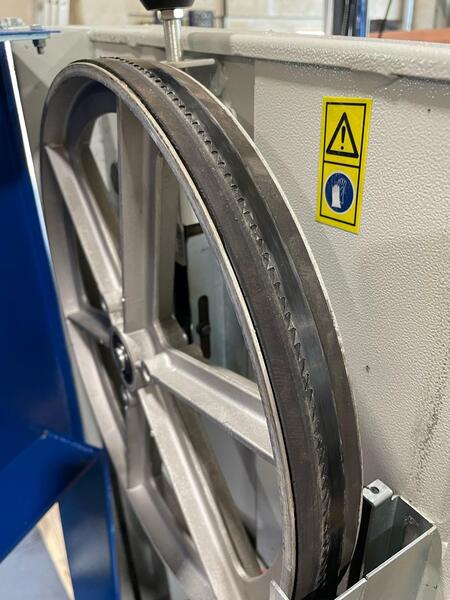
Tension the blade slightly and set it on the upper wheel so that the gullet (the lowest point between the teeth) is in the middle of the wheel width. You change the position by tilting the upper wheel with the tracking knob behind it. Turn the wheel by hand as you do this (mind your fingers) and watch where the blade settles.
If the blade is so wide that you cannot get the gullet to the centre of the wheel, set it so that neither the teeth nor the back edge overhang the edge of the wheel. The blade should not be wider than the wheel – more in the article Choosing the width of a band saw blade for wood.
On a saw in good condition you can leave the lower wheel alone, as the blade finds its own place there. Just make sure that neither the teeth nor the back edge overhang.
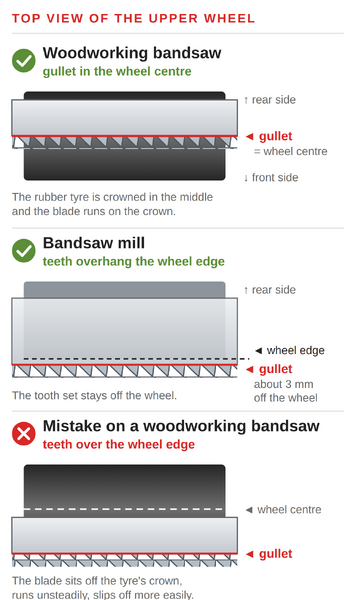
This is the question you ask most often in the discussion. The answer depends on your saw.
Most woodworking bandsaws have rubber tyres on the wheels, slightly crowned in the middle. The gullet belongs in the centre of the wheel, on the crown of the tyre. That is where the blade runs most steadily.
The wheels are flat and the teeth should overhang the front edge of the wheel: on a 32 mm blade the gullet sits about 3 mm off the wheel, a little more on wider blades (follow the saw manual). This keeps the tooth set from being flattened against the wheel.
The advice ‘teeth always off the wheel’ applies to sawmills. If you leave the teeth over the edge on a woodworking bandsaw, the blade sits off the crown of the tyre, runs unsteadily and comes off the wheel more easily.
Step 3
Finish tensioning the bandsaw blade with the tensioner and check:
After final tensioning, check that the gullet is still in the centre of the upper wheel and fine-tune it with the tracking knob if needed.
| Blade | Tension |
|---|---|
| Carbon Flexback woodworking blades | 100–140 N/mm² |
| RipperS PREMIUM sawmill blades | 170–210 N/mm² |
Example for a 32 × 0.9 mm sawmill blade: subtract the tooth height (about 7 mm) from the width, which leaves 25 mm. Tension force = 25 × 0.9 × 200 = 4,500 N (roughly 460 kg).
Lay the broken blade on a flat surface with its outer face down (the side that did not run on the wheel). If it lies flat, the tension was fine. If the ends lift by more than 10 mm or the blade twists, it was over-tensioned – tension it less next time. You will find other causes in the article Why do bandsaw blades for wood break.
Step 4
If you cut tight curves, typically with a 6 mm blade, you may use a grooved rear bearing. Here the gap rule does not apply: the bearing is moved 3 mm forward from its normal position, against the blade, so the blade is pre-tensioned in the groove and its back edge does not deflect in curves. This shifts the blade forward on the upper wheel, so bring the gullet back to the centre of the wheel with the tracking knob.
The back edge suffers more against the bearing and the blade may crack sooner on that side (more in the article Why do bandsaw blades for wood break).
Step 5
Close the covers and run the saw without load. The blade should run smoothly, in one place on the wheel and without clicking against the rear bearing. Then make a test cut. If the cut drifts or is wavy, first check the sharpness of the blade and the tooth pitch, then the tension and the guides. You will find blade speed and feed pressure in the article Technical set-up of a band saw for wood.
Step 6
Leaving the blade tensioned for long periods strains the blade, the wheels and the saw frame, and leaves dents in the wheel tyres. So release the blade tension after work, and tension and check it again before the next job. Do not tighten the blade while it is still warm from cutting: once it cools, it would be over-tensioned. For how to clean and store blades, see the article Proper maintenance of band saw blades.
Only on a bandsaw mill. On a woodworking bandsaw, the gullet belongs in the centre of the wheel. The illustration above shows the difference.
Most often it is under-tensioned or badly positioned: tension it more and tilt the upper wheel to bring the gullet to the centre. If the blade still comes off, check that the wheels run true, that the tyres are firmly seated and undamaged, and that both wheels are in the same plane.
No, you only set the position on the upper wheel. On the lower one, just make sure that neither the teeth nor the back edge overhang. If the teeth overhang, move the blade slightly back on the upper wheel; if the back edge does, move it forward.
It may be, but more often the blade has too many teeth for the thickness of the wood, is too thin or is dull. For boards of around 3 cm, choose coarser teeth, such as 4 TPI. For how to choose a blade, see the article How to choose a bandsaw blade for wood.
Do you have your own experience with tensioning, or a problem that keeps coming back? Write to us in the discussion below the article.

Good morning, thank you for your message and for reading our article. I understand your doubt – it’s a topic on which there are different opinions, especially among users of different machines. In our article, we refer to modern bandsaws, where the flywheels are slightly crowned. In this case, the correct position of the blade is where the root of the tooth is approximately in the center of the flywheel, because it ensures greater stability and a more precise cut. Regarding the alignment, with correct adjustment, the contact of the teeth with the flywheel coating is minimal and does not cause deformation. The ratio between the width of the flywheel and the blade is also important. For example, on many machines (like the Scheppach Basa4) the flywheels can be about 40 mm wide, but the maximum recommended blade width is around 20 mm. This shows that the blade does not have to occupy the entire width of the flywheel. The method with the teeth slightly outside the flywheel may work on older machines, but generally leads to less stability during cutting.
If the cut is not straight, the cause is often: unsuitable tooth pitch (TPI), blade too narrow, incorrect tension or guide.
If you wish, we can recommend the most suitable blade for you.
Sincerely, Dudr Saw team
Dear customer, for a carpentry band saw, the saw band should be positioned so that the back of the tooth is in the middle of the wheel's width. If you have a band saw for tree trunks, the teeth of the band saw should be outside the wheel. If your saw blade falls off, you should probably tilt the wheel slightly so that the blade does not fall off the wheel. When idling, there should be a gap of approximately 1 mm between the saw blade and the rear guide. The saw blade can lean against the rear guide when cutting. Best regards, the Dudr Saw team
Thank you for the feedback! We are glad that you found the article useful and that it helped you with the correct setting of the band. If you have further questions, we will be happy to help. Sincerely, the Simonds team
Good day, thank you for your inquiry. Unfortunately, we have not encountered such a problem before, so it is difficult to advise. It occurs to me to check if the wheels are not wobbling too much (if they are not warped or deformed) (if you have one, I would use a dial indicator), whether the rubber on the wheels is not deformed in places or whether it adheres firmly to the wheels. Whether the wheels are aligned. When you rotate the saw blade in the direction of cutting, it should sit on the wheels exactly the same as when you rotate it in the opposite direction (at least with stationary saws it is like that). This would most likely mean that the wheels are not aligned (opposite each other - in axis). If there are any deviations in tensioning, whether the wheel does not bend, e.g. under greater tension... If it is a new machine, then exchange it for another unit, which sellers are usually accustomed to and do not look for the cause in such inexpensive machines.
Thank you, I hope my advice will be of some use ;-), good luck. Pavel Dudr
Good afternoon, we recommend positioning the saw blade on the upper wheel so that the lower part of the tooth (tooth root) is in the middle of the wheel. It may happen that the saw blade is not completely straight and is so-called crowned, or the wheels are not exactly opposite each other... In your case, I would check that the blade on the lower wheel does not run off the wheel. If it runs off the wheel, I recommend positioning the saw blade a little further back on the upper wheel. Set the guide 1 mm from the back edge of the saw blade after you have centered the blade. The main thing is that the blade can be centered and does not wander.
Thank you, regards
The Simonds Team
Good day, thank you for your inquiry, unfortunately we do not sell spare parts for band saws, we only produce and sell saw bands for all brands and types of machines.
I can only advise you to search the internet for the spare part code 73220026 that I found. For example, here they most likely offer it:
https://www.kutil.cz/elektricke-naradi/nahradni-dily/guma-kola-pro-pasove-pily-scheppach/
In addition, the rubberizing of wheels up to a diameter of 530 mm is done by the company AGT Zlín, but you would have to send the wheels there and the price will probably be different.
I wish you a nice day, good luck!
Pavel Dudr
Good day, that's strange, we haven't dealt with anything like this before. The rubber on the wheels should never move anywhere. By tilting the upper wheel with the screw at the back, you should adjust the saw blade so that it runs in one place roughly in the middle of the upper wheel, then move and adjust the guides to the blade (the blade should only lean back when cutting). If the blade doesn't behave like that, it's likely a problem with the machine. If the saw is under warranty, I think they are willing to replace the machine for you, that they don't worry too much about it. Many people buy blades for these machines from us and have no problems, even with a thickness of 0.65 mm. Of course, the thread can strip when tensioning or the plastic wheel can spin when tensioning or tilting the wheel, etc. In this price category, most machines are the same, so we cannot advise you. Feel free to call us, we can discuss it over the phone as well. Thank you, good luck, regards Pavel Dudr
Good day, it is probably a JESAN PS-400 saw (which is a copy of RATIONA 400 and was produced by KOVO-DŘEVO OPP JESENÍK), of which there are quite a few in the Czech Republic.
Unfortunately, I do not know the length of the saw and cannot find it. You will have to measure it, for example with a string.
SK
Good day, thank you for your inquiry, but we only manufacture saw blades for these machines.
Regarding your questions:
1) The problem is likely too many teeth in the cut - use a larger tooth spacing (lower TPI number) or a blade that is too thin. The manufacturer puts 0.36mm blades "in the box", but a blade thickness of 0.5mm or possibly even 0.65mm is more suitable here. However, a thickness of 0.65mm is already for a wheel diameter over 325 mm (0.65x500=325) and on smaller wheels, the saw blade could break due to the small bend. If the problem is something else, you can review the problems with saw blades for wood and their solutions. https://www.dudrsaw.eu/technical-articles-and-advice/why-do-band-saw-blades-for-wood-break-we-know-the-answers
2) We manufacture saw blades to measure for every bandsaw, so you can buy from us. Simply enter the length 1400 (for your saw) into the configurator on the homepage, and it will guide you. For this saw, I would recommend the 1400x10x0.5 TPI 4 blade or a smaller tooth spacing TPI 6. However, if you are cutting shapes, then for sure choose an even narrower blade 1400x6x0.5 TPI 4 or a smaller spacing TPI 6.
Overall, we have a good article on choosing a saw blade: https://www.dudrsaw.eu/technical-articles-and-advice/how-to-choose-a-band-saw-blade-for-wood-2
If you would like advice, feel free to call.
All the best, regards, the Dudr Saw team.