
How to tension a bandsaw blade for wood?
18
Full article
A bandsaw blade for wood most often cracks when it is over-tensioned, when it is too thick for the saw's wheels, or when it rests against the back bearing even when running idle. You can usually tell what caused a crack from where it starts. Our welds come with a warranty.
Look at where the crack starts. Its location usually reveals the cause.
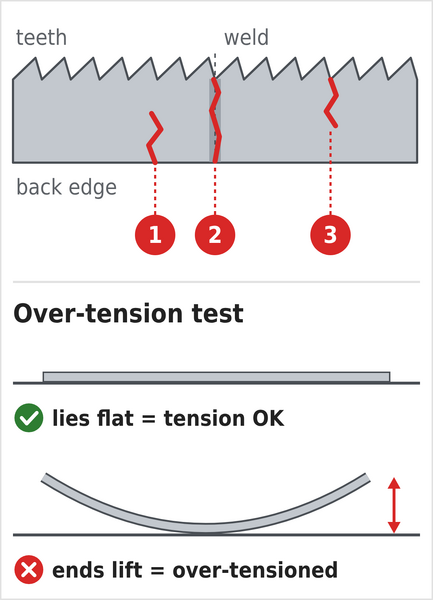
On a standard two-wheel saw, the blade bends around the wheels twice and straightens out twice on every revolution. Anything that puts extra stress on it shortens its service life. Here are the five main causes.
Tension
An over-tensioned blade will most likely crack sooner or later – at the weld or elsewhere.
Check without a gauge
After work
| Blade type | Recommended tension |
|---|---|
| woodworking blades | 100–140 N/mm² |
| sawmill blades | 170–210 N/mm² |
Example for a 32 × 0.9 mm sawmill blade: subtract the tooth height (about 7 mm) from the width, which leaves 25 mm. Tensioning force = 25 × 0.9 × 200 = 4,500 N (roughly 460 kg). You will find the full procedure in the article How to tension a bandsaw blade for wood.
Blade thickness
The smaller the wheels, the more sharply the blade bends on every revolution. The rule is simple:
This is a recommendation, not a prohibition – you can fit a thicker blade on the wheel, it will just be under more stress. If your blades keep cracking on a small saw, try a thinner one: 0.5 mm (we make it in widths of 6, 10 and 13 mm), or 6 × 0.36 mm. A thinner blade copes better with bending over a small wheel, but it is less rigid and wanders more easily in the cut. That is why, with a thin blade, you should choose the greatest width your work and your saw allow.
Bearing and guides
If the blade rests against the back support bearing even when running idle, its back edge gets peened, hardens and eventually cracks. The cracks then start from the back edge.
What to adjust
Watch out for
Weld
Does it keep cracking at the weld?
We describe how to recognise a quality weld, when the warranty covers it and how to make a claim for a cracked weld in the article Bandsaw blade welding: quality welds and warranty.
Service life
A worn blade with dull teeth will often crack due to material fatigue, sometimes even at the weld. This is not a defect but the natural end of its service life. You can extend it like this:
Do not force the cut
Feed pressure should be light and steady. If the blade will not cut that way, increase the blade speed, slow down the feed, choose a larger tooth or replace the blade with a sharp one.
Choose the speed to suit the job
Reduce the speed for fine work – this can extend the service life up to threefold. Rough cuts in soft and green wood need a higher speed so that the blade can clear the sawdust fast enough.
New blade, new cut
Do not use a new blade in an old cut.
You will find more tips in the article Principles of proper bandsaw blade maintenance.
Need a thinner or different blade?
We will weld it to measure for your saw. All you need is the size, or just the saw model.
The blade is not cracking, but it cuts badly? Rough or crooked cuts, burnt wood and a blade that dulls quickly usually have a simple cause.
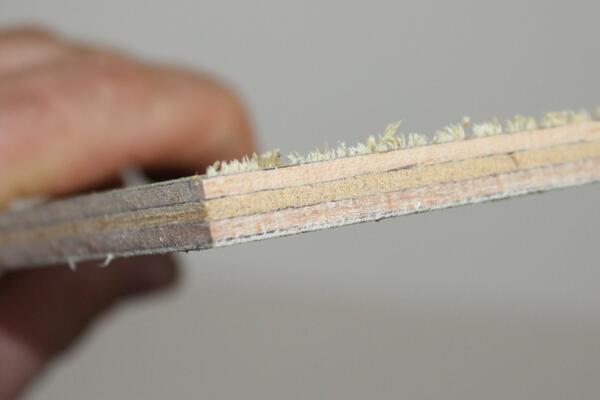
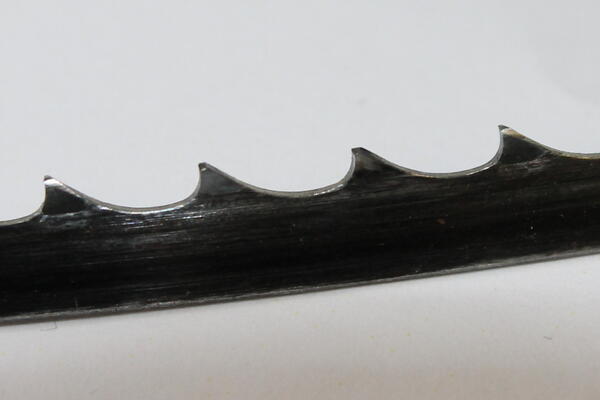
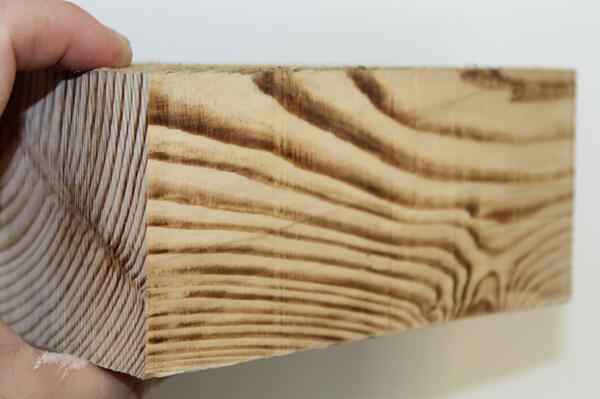
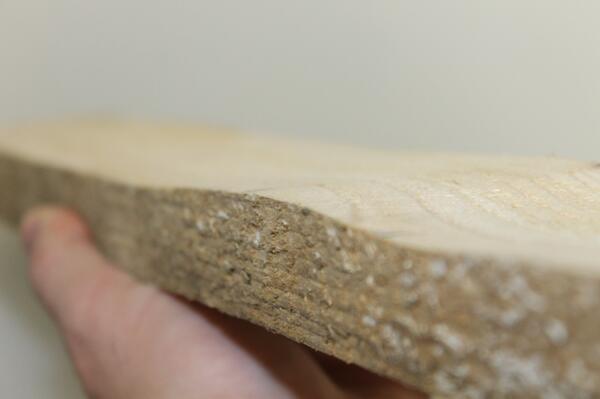
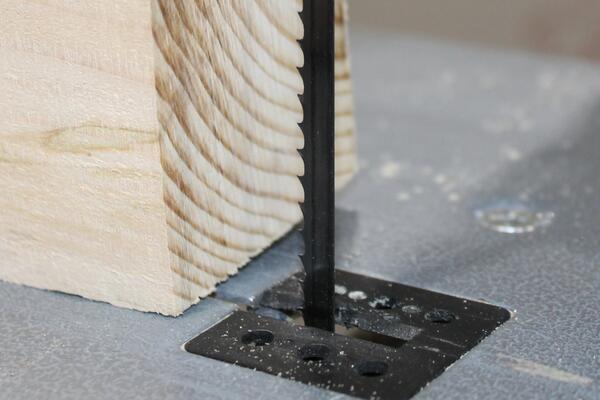
That is very unlikely. It could only happen if the saw were extremely clogged and the sawdust deformed the blade.
Multiply the blade thickness by 500: a 0.65 mm blade needs a wheel diameter of at least 325 mm, a 0.5 mm blade at least 250 mm. You can use a thicker blade, it will just be under more stress as it passes over the wheel.
To 170–210 N/mm², in practice roughly 200 N/mm². Tension woodworking blades to 100–140 N/mm². You will find an example calculation above.
It is most likely not the back guide – the cracks would then start from the back edge. Check whether the wheels are in line with the guides. Unsuitable sharpening can also be the cause. We will be happy to advise you on sharpening and servicing sawmill blades – just write to us.
If there is no obvious weld defect on the blades, the cause may also lie in the saw, its set-up or the way you cut. Go through the tension, blade thickness and back bearing. If you are not sure what to do, write to us.

Hello, I am attaching a link to Parkside wood saw blades
https://www.dudrsaw.eu/technical-articles-and-advice/blades-for-the-parkside-wood-band-saw-from-lidl
Good day,
most saws require the flywheels to be re-rubbered.
For example, the company AGT in Zlín deals with the renovation of these wheels.
https://www.agtzlin.cz/pogumovani-obezneho-kola-na-pasovou-pilu-p320/
Sincerely,
Vojtěch Volf
Good afternoon, we would be happy if you try our saw blades. If the blades generally break on such a small bandsaw, we recommend a blade thickness of 0.5 mm due to the small wheels. These are blades of width: Flexback 1490x6x0.5 mm or Flexback 1490x10x0.5 mm. Choose the pitch according to the height of the wood being cut or whether you are cutting softwood or hardwood. If the blades break at the weld and too soon, it is more likely due to poor welds, so I would normally recommend a thickness of 0.65 mm, the blade is tougher and holds better in the cut. We have a larger selection there. These are widths: Flexback 1490x6x0.65 mm, Flexback 1490x8x0.65 mm, Flexback 1490x10x0.65 mm. Again, choose the pitch according to the cutting height you are cutting. If a blade from us breaks, you can complain about it to us by sending us a photo of the broken weld. We will assess the broken weld and usually send you a new one immediately. If there is still a problem with breaking at the weld, we would have to look for the cause in the machine itself, but we do not encounter problems with saw blades breaking at the weld on these bandsaws.
Thank you, good luck, regards Pavel Dudr
Good day, there could be several reasons. We would need more information and to see the saw band, at least. It could have happened, for example, due to undercutting during production.
Please contact your colleague Martin Dvořák from the company Dudr Tools tel.: +420 776 566 103.
Thank you, Regards Pavel Dudr
Good afternoon, thank you for your comment. We apologize, there should definitely be more.
If you are going to use the RipperS PREMIUM saw blade intended for logs, expect a tension of 170-210 N/mm2.
Woodworking saw blades FlexBack are tensioned to 100-140 N/mm2.
Good luck, best regards, the Dudr Saw team.
Hello, that is very unlikely.
Theoretically, it could happen if you had a very dirty saw - but it would have to be an extreme build-up of dirt that deforms the blade.
Good day, there is no need for a table for that. It is "wheel diameter / 500".
But that is a recommendation, of course you can use thicker ones too, it's just that the band will be a bit more stressed when passing over the wheel.
S.Kolarik
Hello, we recommend 200 N per mm2 of the saw blade's cross-section. For example, if you have Ripper 32x0.9, after subtracting the tooth height (about 7 mm), we get 25 x 0.9 x 200 = 4500 N/mm2.