
Choosing tooth pitch for a band saw blade for wood
10
Full article
Not all teeth are the same. When you search online for band saw blades for wood, you will most often come across blades with hardened teeth, sometimes perhaps with non-hardened teeth. In our e-shop you will again find blades with hardened or carbide teeth. But what does this actually mean and what is the difference between the tooth types? We answer everything below – just keep reading…
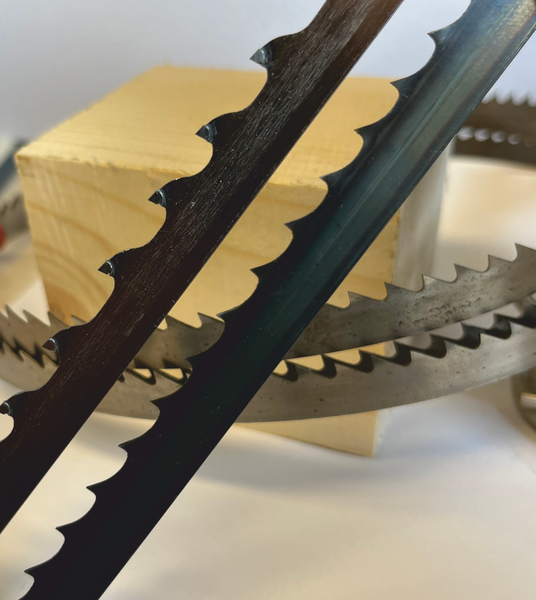
The absolute basic type are band saw blades with non-hardened teeth – this is how wood-cutting band saw blades used to be made. For this type it is characteristic that the cutting edge of the teeth is made of the same material as the rest of the blade and therefore has the same properties. In terms of hardness, we are talking about roughly 45 to 50 HRC (a unit of metal hardness). And that is the problem.
Band saw blades should ideally have a flexible body so that it can withstand repeated bending over the wheels, but at the same time hard tooth tips so that the cutting edge stays sharp for a long time.
Blades with hardened teeth (in our e-shop we offer Flexback) have a similar body, but the tooth tips are hardened to a hardness of 55 to 57 HRC. Thanks to this, such a blade should offer roughly three times the tool life when cutting soft wood compared with blades with non-hardened teeth.
To give you an idea, the hardness of a typical snap-off knife blade is between 60 and 62 HRC. It is a similar carbon steel – hard but also brittle, so that the knife can be snapped off.
And finally there are wood-cutting band saw blades with carbide teeth (in our e-shop we offer CarbideWood – we describe them in more detail here). These are unique in that a strip of carbon steel has sintered carbide welded onto the tooth tips. The hardness of such a material is approx. 90 HRC, so the band saw blade should be able to cut roughly ten times more than a blade with hardened teeth.
When looking for information about band saw blades you will often come across other terms, such as carbon blade, spring blade or carbon steel blade. It is important to understand what such a term actually describes – in these cases it refers to the material from which the whole blade is made, and all three terms denote the same type of material. In other words, a carbon, spring or carbon-steel blade all mean the same thing; people just use different names.
At the same time, it is likely that these are blades with hardened teeth; only exceptionally will such blades have non-hardened teeth.
You may also have come across bimetal blades. By their design they are intended primarily for metal (tooth angles, amount of set) – for normal woodworking, bimetal blades are not really worthwhile because of their price, and that is why we do not offer them for wood. The only exception is a 34 mm-wide blade intended for cutting logs.
And which tooth type has worked best for you? Share your experience with us and with other readers in the comments below the article.

Thank you for your inquiry. For your machine, we would primarily recommend this saw blade:
Flexback 1070x6x0.36 mm TPI 10 Regular - We would choose the 0.36 mm thickness due to the small wheel diameter.
If you wish to experiment, you can also try thicker blades:
Flexback 1070x6x0.5 mm TPI 6 Skip
Flexback 1070x6x0.65 mm TPI 10 Regular
However, with thicknesses of 0.5 mm and 0.65 mm, there is a risk of cracking due to the small wheels, but these are stiffer, so in some cases they may provide better cutting stability.
Best regards, Simonds team
Hello, the choice of tooth shape depends mainly on the material being cut and the type of cut.
Regular (standard tooth)
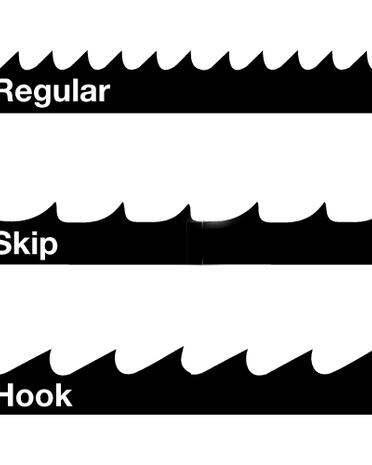
It is the most universal tooth shape. It is suitable for most applications, especially for cutting wood, thinner materials, or for general cutting.
Hook (tooth with a positive angle)
This type of tooth has a more aggressive angle and is suitable for harder materials or for faster cuts. It is often used for longitudinal cuts in solid wood or thick materials.
Skip (tooth with a large space between teeth)
It has a larger space between teeth, which helps with sawdust evacuation. It is particularly suitable for soft wood, green wood, or for materials that produce a lot of chips.
If you can write to us: band dimensions (length × width × thickness)
the material you want to cut, approximate diameter or thickness of the material, we can recommend the appropriate blade.
Sincerely, the Dudr Saw team
Hello, for the Makita LP1200 band saw, narrower blades are usually used. We offer Carbide Wood blades with carbide teeth, in widths of 13 mm and 20 mm. In the case of a 20 mm width, it is important to check if it fits your machine and if the saw can tension and guide it correctly. Carbide Wood blades are "coated" blades, meaning they have carbide-tipped teeth. These blades are not usually sharpened. Unfortunately, we do not know of anyone who practically offers resharpening services for this type of blade. From our customers' experience, we know that a carbide-tipped blade stays sharp several times longer than a standard wood blade with hardened tooth tips. Of course, it is necessary for the band saw to be in very good technical condition (correct guides, correct tensioning, stable operation).
You can find more information about the Carbide Wood blade here: https://www.dudrsaw.eu/band-saw-blades/band-saw-blades-for-wood/carbide-wood Direct links: Carbide Wood 2240 × 20 × 0.6 mm TPI 1.5–2
Carbide Wood 2240 × 13 × 0.6 mm TPI 1.5–2
Sincerely, The Simonds Team
Hello, thank you for your inquiry. If you are cutting logs with a Woodmizer type saw, we recommend the RipperS Premium saw blades. If you are using saw blades with a width of 50 mm or more (e.g., 80, 90, 100, 120 mm, etc.), we recommend that you contact the company Dudr Tools, which can offer you a saw blade for logs with Stellit teeth, specifically for your saw.
If you were cutting oak with a carpentry saw, we recommend the Carbide Wood saw blades, which are suitable for cutting exotic hardwoods.
In order to recommend a specific saw blade, we would need to know the desired width of the blade.
Thank you and best regards, the Simonds team
Good day, thank you for your inquiry. For such a large dimension, I would recommend a larger pitch of 1.1 TPI (teeth per inch) and for hardwood, the RipperS PREMIUM 3540x32x0.9 TPI 1.1 HARD log saw blade. Here you can find the complete offer of RipperS PREMIUM log saw blades, where the prices are also listed. Thank you, regards Pavel Dudr
Good afternoon,
for this cutting height, we recommend a TPI 4 tooth pitch (material height 20-80mm), or a TPI 3 tooth pitch (material height 25-120mm).
Thank you
Sincerely, the Dudr team.
Good day, for a small kerf and a smooth cut, we can recommend the carbide saw blade CARBIDE WOOD, which is available in widths of 13, 20, and 25mm.
Sincerely, Team Dudr.
Good day, in 95% of cases where the manufacturer indicates 12mm, 13mm can be used without problems.
Standa Kolařík