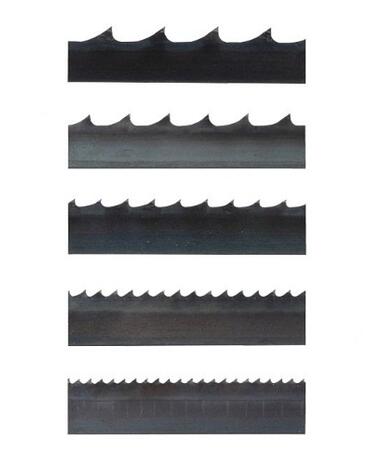
How to choose a bandsaw blade for wood
81
Full article
It all starts with the band saw (the machine) – but which one should you choose? There are countless options on the market and a whole range of aspects customers consider. Because we supply band saw blades for practically all types of machines, we have quite a broad overview. Whether you are a model maker, keen DIYer or professional, we believe we can advise you – and we’ll add tips on the blades that will suit your saw as well. Read on and feel free to share your experience with us in the comments under the article.
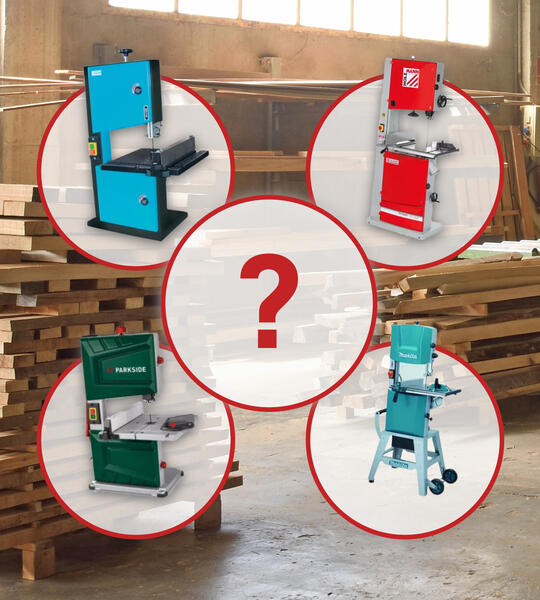
CUTTING HEIGHT. Manufacturers of band saws list the maximum cutting height as one of the key values. However, if you plan to cut at this height regularly, it is better to choose a larger saw. Working long term at the maximum limit of what your saw allows is not ideal. In that case the blades will wear out faster, they may stall in the cut and you can also struggle with insufficient motor power.
Conversely, if you need to do fine work (for example contour cutting or very precise cuts), don’t overdo it with the size of the machine. An overly thin blade on an overly large saw can paradoxically be less stable. In short – large machines are suitable for cutting large dimensions and small machines for cutting small dimensions.
CUTTING WIDTH. This can be described as the size of the workpiece that fits between the frame of the machine and the saw blade. This value is often given as the so-called throat capacity and depends on the size (diameter) of the wheels. There is a simple rule of thumb – the larger the wheels, the greater the cutting width (note: this does not apply to band saws with a three-wheel design).
If the manufacturer does not specify the wheel diameter, it can usually be estimated, as it will be only slightly smaller than the cutting width. It is also worth remembering the thickness of the fence – if you want to place it between the frame and the blade, the usable cutting width will be reduced.
OLDER AND USED BAND SAWS. Do you have a machine in the workshop that has already seen some years of service? Or are you thinking about buying one second-hand, for example from a classifieds site? If so, it is useful to know that such band saws are usually not only heavier and more rigid (they really didn’t skimp on material in the past), but also simpler – for example without a fence, scale or a quick-release blade tension system. From our experience it usually pays off, at the very least, to refurbish the blade guides and re-rubber the wheels, possibly replace the bearings and make a new fence.
NEW BAND SAWS. If you decide for a brand-new machine, which one should you choose? What is each saw suitable for? And with which band saw blades will it work best? To make your choice easier, we have prepared a practical overview with specific tips. For this purpose we distinguish three categories of band saws according to wheel size (diameter):
Don’t forget that when choosing a machine, the materials it is made of and the price are also important aspects. You can say that the price reflects not only quality but also productivity. Cheaper machines tend to use thinner sheet metal, only the table is cast iron at best, and the motor power is usually lower. A major drawback can be plastic parts (screws, levers, etc.), which you can easily twist off or break with frequent use or too much force. For those who only use the saw occasionally, a cheaper option may be sufficient, but for professionals we would recommend a more expensive machine.
💡 Ideally, try the saw somewhere before buying. And if that’s not possible, YouTube videos can at least help you get a better idea of how the chosen machine works in practice.
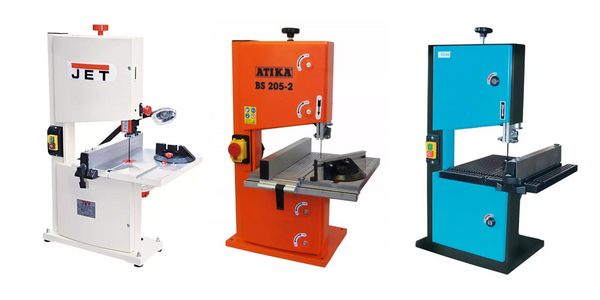
These are the smallest band saws. Typical features include 220 V power supply and a fixed blade speed (600 or 900 m/min). These machines usually have a side fence, a simple tilting table (0° to 45°) with dimensions around 300 x 300 mm and, in some cases, a mitre gauge. From our experience these saws are suitable for cuts up to 5 cm in height (exceptionally up to 10 cm, but at the cost of lower performance).
Examples of small band saws: JET JWBS-9X, HECHT 8925, Einhell TC-SB 200/1, LIDL Parkside PBS 350 A1, Atika BS205, Güde GBS 200, Roxta RPP-225.
🔥 OUR TIPS: In this category the most commonly used blades are 1400x6x0,5 mm TPI 6 Skip and 1400x6x0,5 TPI 4 Skip. For the finest contour work the narrowest blade in our range is ideal: 1400x3x0,65 mm TPI 14 Regular.
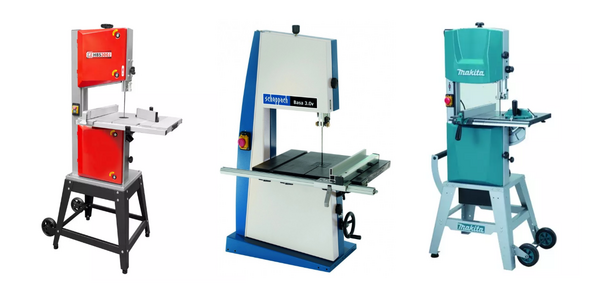
They are most often powered from a 220 V supply and have a tilting table (up to 45° or more) with dimensions of around 500 x 500 mm. Medium band saws usually come with a side fence, a scale for setting the cutting width and a mitre gauge. Some models may also offer handy extras such as work light or a laser guide. A common and useful feature is two selectable blade speeds, or even stepless speed control. (Higher blade speed is suitable for cutting soft wood and large diameters, lower speed for hard wood and smaller diameters.)
Medium-size saws are universal machines that allow both contour cutting and straight cuts. Anyone who has such a machine in their workshop will greatly expand the range of possible operations and projects.
❗️ However, keep in mind that this is not a machine for everyday ripping of 14 cm thick beams. For that type of work the power of a medium saw is usually not sufficient and a large saw will cope much better (and band saw blades with a tooth pitch of TPI 2, which are best suited for this, are 0.8 mm thick and therefore more appropriate for large machines).
Examples of medium band saws: Holzmann HBS300J, Makita LB1200F, Holzstar HBS251, DeWALT DW739, DW 738, Scheppach BASA 3, HBS400.
🔥 OUR TIPS: The most commonly used blades in this category are 16x0.65 with a TPI 3 Skip tooth pitch (for example, for the Holzmann HBS300J-230V we recommend the blade 2240x16x0,65 TPI 3-Skip). You can read more about tooth pitches HERE.
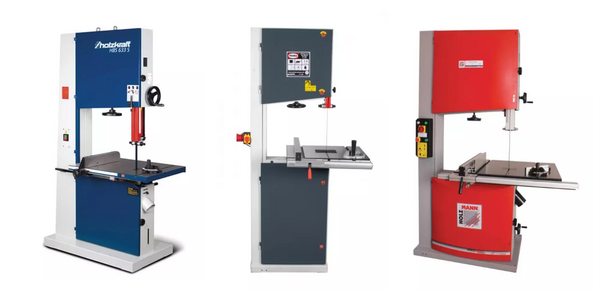
Large band saws are usually powered from a 400 V supply. Practically every such machine has a tilting table roughly 700 mm wide, with various tilting ranges depending on the model. A side fence (with cutting-width scale) and a mitre gauge should be standard equipment, and in many cases you will also find extras such as work lights or a laser guide.
Most large saws should allow the operator to select the blade speed (higher speed is suitable for cutting soft wood and large diameters, lower speed for hard wood and smaller diameters). These machines are powerful and therefore ideal for cutting large sections of timber to size (that is, for straight cuts).
Examples of large band saws: Holzkraft HBS633S, HBS533, PROMA PP-500, Holzmann HBS800, Scheppach Basa 4, JESAN KOVO PPW800.
🔥 OUR TIPS: The most commonly used blades in this category are 19x0.8 with a TPI 3 Skip or TPI 2 Hook tooth pitch (for example, for the LAGUNA 14BX we recommend the blade 2946x19x0,8 TPI 3-Skip). You can read more about tooth pitches HERE.
🔎 So, have you already chosen your saw? Will a smaller model be enough, or will you go for a larger one? Whatever machine you decide on, remember that high-quality band saw blades are just as important. Try ours, for example. In the search tool HERE we will recommend individual blades and complete sets tailored to your specific saw so that you can get the most out of it. (You can find more about searching for blades by machine in the article HERE.)

Good day, thank you for your message and your order. The Carbide Wood bandsaw blade must be resharpened using a diamond wheel. In addition, it features a variable tooth pitch, meaning the distance between teeth is not constant. Unfortunately, we are not currently aware of any company that offers resharpening services for narrow blades that also handle carbide-tipped teeth. However, the service life of the cutting edge on Carbide Wood teeth should be several times longer than that of hardened teeth, such as those on the Flexback blade. Many customers have confirmed to us that they can cut up to 10 times more with a Carbide Wood blade than with a blade with hardened teeth. Of course, to achieve such a service life, the machine must be in very good technical condition, and the blade must not be damaged for other reasons before the teeth become dull—for example, due to blade breakage caused by improper use, incorrect machine settings, etc. We wish you every success and hope you will be satisfied with the Carbide Wood blade.
Sincerely, The Simonds Team
We are glad you like the article. Below is a link to purchase the saw blade and a description of the tooth shape.
https://www.dudrsaw.eu/band-saw-blade-configurator-for-wood/produkt-61/1400/6-x-0-50/6-skip?source=configurator
https://www.dudrsaw.eu/technical-articles-and-advice/tooth-shape-band-saw-blade-for-wood