How to choose a bandsaw blade for wood
81
Full article
Your saw sets the blade length and only limits the width and thickness, and you choose the tooth pitch for what you cut. You don't need to look up the sizes in the manual: just find your saw in our bandsaw finder. Our database holds over 2,000 bandsaws, and for each one we show the blade size and the blades we recommend for it.

Overview
Which bandsaw blade you need is decided first by the saw itself: it is built for a blade of certain dimensions. The length comes from the wheels and the distance between them, the width from the wheels and guides, and the thickness from the wheel diameter. The saw has no say in the teeth: you choose those to suit the material and the depth of cut.
| Blade size | Saw for wood | Saw for metal |
|---|---|---|
| Length | set by the saw | set by the saw |
| Width | the saw sets the range; you choose for curves or straight cuts | set by the saw |
| Thickness | the saw's wheel diameter sets the maximum thickness | usually set by the saw |
| Pitch and tooth shape | you choose them to suit the wood and the depth of cut | you choose them to suit the material and the section |
Jump to:

Sizes
You'll find it fastest in our bandsaw finder. If your saw isn't there, you'll find the size in the manual or on the old blade; copy the exact model from the machine's rating plate so you know what to look for. Our blades carry their own label with the size and a QR code you can use to reorder the same blade, see Ordering with QR codes.
The saw can't adapt to a different length. The tensioner only makes up a small difference, and a blade outside its range either won't go on or won't tension. If you can't find the length anywhere, measure the old blade by rolling it along the floor (wear gloves), or unplug the saw, slacken the tensioner and run a piece of string round the wheels. The step-by-step method is in the article How to determine the length of a bandsaw blade. We'll weld you a blade to exactly the length your saw needs, even if you can't find it in the catalogue.
A bandsaw for wood takes a range of widths, and the manual gives the widest blade. For straight cuts and resawing, use the widest blade the saw allows, because it holds its line in the cut. You need a narrower blade mainly for curves. The thickness is limited by the wheels: small wheels call for a thinner blade. You'll find the width for each curve radius and the thickness for each wheel diameter in the tables in the article Choosing the bandsaw blade width for wood.
A bandsaw for metal has a fixed blade width, and almost always a fixed thickness too. The exception is the 13 mm width, in which we supply blades in both 0.65 and 0.5 mm; the manual tells you which thickness your saw can take.
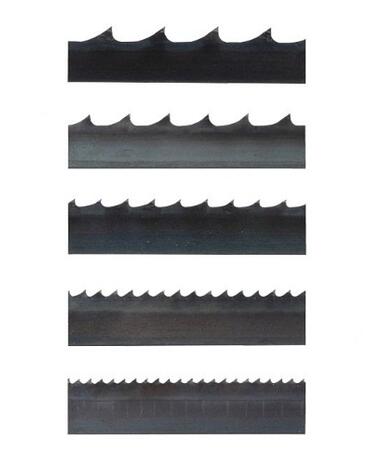
The saw doesn't set the pitch: you choose it to suit the material and the depth of cut. The saw only limits it indirectly, because blades of each width are only made in certain pitches. We supply over 40 combinations of pitch and tooth shape, from 0.7/0.9 TPI for large metal-cutting saws to 24 TPI for the thinnest material. We explain how to choose the pitch for wood in the article Choosing tooth pitch for a bandsaw blade for wood, and for metal in the article How to choose a bandsaw blade for metal.
In our shop
These are the saws our customers outside the Czech Republic own most often. One click takes you straight to the blades and the set for each of them.
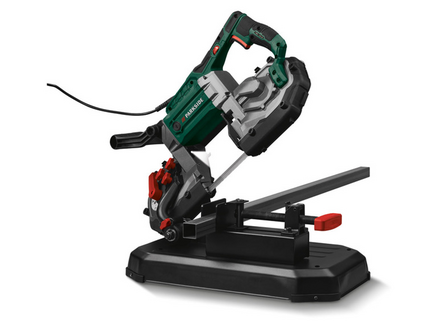 ParksidePMB 1100 B2for metal · 1140 mm bladeBlades and set →
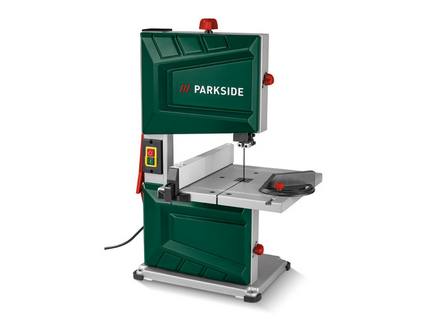 ParksidePBS 350 B2for wood · 1400 mm bladeBlades and set →
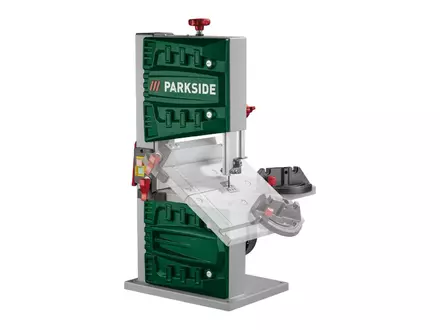 ParksidePBS 350 C3for wood · 1400 mm bladeBlades and set →
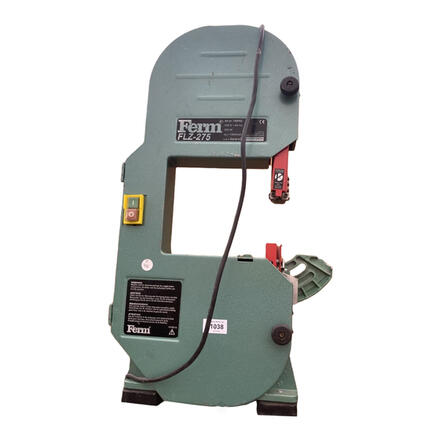 FERMFLZ-275for wood · 1425 mm bladeBlades and set →
Ranked by how often, over the last 12 months, visitors to our online shops outside the Czech Republic searched for blades for these saws and bought sets for them.
Post the brand and model of your saw in the comments below this article or email them to info@dudrsaw.eu, and we'll add it to the database. Since the start of 2026, we have added 43 saws to it. If you know the dimensions from the manual, you don't have to wait: order the blade in the configurator for wood or for metal.
Sets
For some saws we have a set of three blades with a 5% discount. The blades in the set are the right length for your saw and differ in width or pitch. That way you find out which one works best for your jobs, and next time you order just that one. You'll see which sets we offer for your saw on its page.
Starter for wood
Straighter
Shaper
Starter for metal
Database
Most of the saws in the database are for metal: over 1,800 machines, from portable saws to large production bandsaws. There are over 130 saws for wood from 48 manufacturers, plus saws for bricks and building materials, and saws for meat.
For wood: ACM, Atika, Bernardo, Centauro, Compa, Cormak, Dedra, Detoolz, DeWALT, Dictum, Drda, Einhell, Ferax, Ferm, Güde, Hammer, Hecht, Hema, Holzkraft, Holzmann, Holzstar, JET, Jolly, Kraft&Dele, Laguna, Mafell, Makita, MEEC Tools, Metabo, Mikeska, O&M, Parkside, Perfekt, Powermat, Proma, Protool, Proxxon, Record Power, Rojek, Roxta, Ryobi, Scheppach, Toolson, Vevor, Villager, Womax, Zipper, Český Brod
For metal: Amada, ASIST, Bauer, BDC, Behringer, Berg & Schmid, Bernardo, Bianco, Bomar, Bosch, BS, BTM, Carif, Cormak, Cosen, Daito, Danobat, Dedra, Delta, Dema, DeWALT, DoAll, Einhell, Eisele, Elmag, Everising, Femi, Flex, Flott, FMB, Forte, Friggy, GCB, Güde, HEM, Heska, Holzmann, Huvema, Hyd-Mech, Indore, Jaespa, JJ Machine Tools, Kaltenbach, Kasto, KMT, Kovopodnik Praha, Kraft&Dele, LK, Makita, Marvel, Matrix, Meba, Mega, MEP, Metalin, Metallkraft, Metora, Milwaukee, Missler, Mössner, Müller, Optimum, Parkside, Pedrazzoli, Pegas-Gonda, Pehaka, Pilana, Pilous, Proma, PTX, RES, Roxta, Rüsch, Sabi, Scheppach, SPM, Stiler, TM Jesenice, Trennjäger, UMS, Vevor, Wagner, Way Train, Woo Sung, Yato
For bricks: Avola, Elfatech, Lissmac, Norton
For meat: Kolbe
Reader questions
Yes. On the saw's page we show the blades that have worked best on it. You can order a different pitch or series in the same size in the configurator for wood or for metal: enter the length, width, thickness and pitch, and we'll weld the blade to exactly those measurements.
Type the blade length from the manual into the bandsaw finder. For the saws it finds, compare the blade width and thickness, and check whether it is a saw for wood or for metal. If everything matches, the blades from their page will fit your saw, even if we list it under a different brand. Then choose the pitch for what you cut.
The make-up of each set is fixed. If you want different blades, order them individually, or tell us what you cut and we'll recommend a combination.
Not sure which bandsaw blade or set to choose? Tell us your saw model and what you cut on it most often, in the comments below this article or at info@dudrsaw.eu.

Hello, try the Epic GP bimetallica 1141x13x0.5 TPI 14/18. Kind regards from the Dudr Saw team
Good day, thank you for your inquiry. The bandsaw blades for cutting logs (RipperS Premium) are handled by our partner company Dudr Tools. They provide a complete service for log bandsaw blades and also offer pick-up. Please contact them. Here are the contacts.
Thank you and good luck. The Simonds Team
Good day, with a band saw machine intended for cutting metals, you can generally cut wood, but it's good to be aware of a few things. The band speed is usually about 10x lower than on a wood band saw. Also, the tooth pitch on metal cutting saw bands is smaller than on wood cutting saw bands, and the tooth geometry is different (especially the hook and rake angle of the tooth). So, cutting wood can be more difficult. If you want to use a 13 mm wide metal cutting saw band (bi-metal) for cutting wood, it's better to use a larger pitch, e.g., 6/10 TPI (which you probably have). In general, for metal cutting, it is advisable to have 8 to 16 teeth in the cut, for wood cutting it is 2 to 8 teeth in the cut. For shortening wooden material on your 13mm saw, we would recommend trying the Carbon Flexback 730x13x0.65 TPI 4 Hook. In order to simplify the choice for customers as much as possible, we do not directly offer wood saw bands for metal band saws, but anyone can order anything via the configurator.
Thank you for your inquiry, good luck, sincerely Pavel Dudr