


Cooling a band saw blade for metal
8
Full article
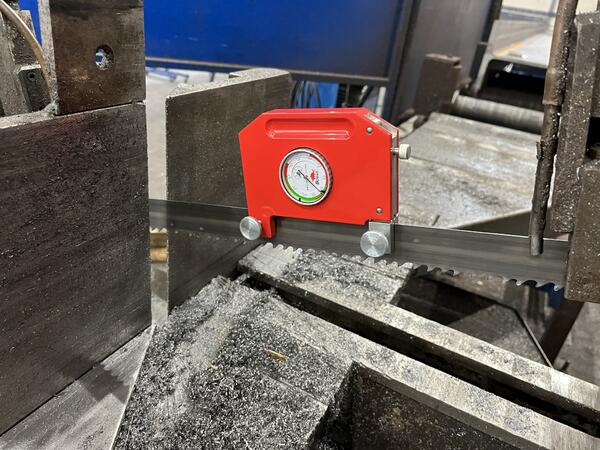
In this article we take a closer look at band saw blade tension. For the band saw blade to cut straight, not undercut and not fall off the band wheel, it must be correctly tensioned. And to prevent it from cracking, it must not be tensioned too much. How can we tell that a band saw blade is tensioned correctly? And how can we measure it? How do we know that we have tensioned the blade too little or, conversely, too much?
How to tension a band saw blade for wood can be found here.
Clean the band saw of chips and dirt using a brush or compressed air from a compressor. Pay attention to cleaning the area around the guiding elements (bearings, carbide guides). Insert the blade into the band saw and tighten it lightly so that it does not slip off the guides. Place the tension gauge between the guides and clamp it onto the band saw blade, then set the indicator to zero. The tension is given in newtons per square millimetre (N/mm2). Gradually increase the tension of the band saw blade until the instrument shows the required value (see the table below).
WARNING – before you buy a tension gauge, make sure it will fit into your band saw. Some smaller hobby band saws have limited space and it is not possible to clamp a tension gauge measuring 131 x 100 mm into them. If you cannot use a tension gauge, you can make a visual check of the disc springs – the disc springs that form part of the tensioning system of most manually tensioned band saws should not be compressed fully.
After tensioning, briefly switch the band saw on and let the blade settle (it is enough to let the blade run through the band saw idle three or four times). Then check how the blade is seated in the band saw. The back edge of the blade must not touch the flange (the rear lip on the band wheels); there must be a “fingernail-width” gap, i.e. approx. 1 mm. The blade must also not touch the rear edges of the carbide guides. All bearings must rotate freely (check this before fitting the band saw blade); if they do not work properly, they will cause premature damage to the band saw blade.
Check that the blade is straight between the guides using a 30–40 cm offcut of band saw blade, which you insert into the empty band saw. Check that the blade is perpendicular and firmly fixed between the bearings (it does not wobble sideways) and at the same time can be moved forwards and backwards freely enough (it must not rub excessively). On request we can include a band saw blade offcut with your order free of charge.
NOT ENOUGH TENSION. The band saw blade undercuts and does not cut straight. It may also slip off the band wheel.
OVER-TENSIONED, TOO TIGHT. The band saw blade breaks prematurely; it may crack in the weld or outside the weld, and microcracks often appear around the circumference of the band saw blade.
To check whether the band saw blade was over-tensioned, place the broken blade on the floor or another flat surface with the outer side down (the side that was not lying on the band wheel). If the blade was not over-tensioned, it will lie flat on the surface. If it was over-tensioned, the ends will lift noticeably (by more than 10 mm) or it will not be possible to lay it flat on the surface at all.
💡 You can find a tip on how to solve other problems as well in the article Why do band saw blades for metal break? The most common problems.
| Band saw blade dimension | Tension force |
| 13 x 0,65 mm | 130-150 N/mm2 |
| 20 x 0,9 mm | 160-180 N/mm2 |
| 27 x 0,9 mm | 200-220 N/mm2 |
| 34 x 0,9 mm | 240-250 N/mm2 |
| 41 x 1,3 mm | 250-260 N/mm2 |
| 54 x 1,3 mm | 260-280 N/mm2 |
| 54 x 1,6 mm | 260-280 N/mm2 |
| 67 x 1,6 mm | 260-280 N/mm2 |
| 80 x 1,6 mm | 280-300 N/mm2 |

Hello, thank you for your query. Based on your description, we would not primarily look for the problem in the actual setting of the blade position on the wheels, because if the blade runs correctly when idling and only starts to fall off after cutting into the material, the problem likely only manifests itself under load. We would recommend checking, above all:
saw blade tension – if the blade is not tensioned enough, it may run correctly when idling, but start to slide off the wheels when cutting
play in the wheel mountings and bearings – under load, one of the wheels may shift slightly and change the blade guidance
guide roller settings – the side rollers should only guide the blade with minimal clearance; they should not pinch it or push it to the side
rear support bearing – during the cut, it should catch the pressure of the blade towards the back, but it should not push the blade forward significantly,
blade load during the cut – if you have already tried various guide settings, it would be worth verifying whether the problem changes during a very light cut and minimal blade load. If the blade held in such a mode, it would point more to a problem with tension, guidance, or wheel geometry under load.
If you have another saw blade available, we would recommend trying it as well. With the current blade, the problem may be, for example, in the weld, a slight twist, or another deformation of the blade.
According to your description, we would check firstly and mainly the correct blade tension and any wheel play. The actual position of the blade about 1 mm from the edge of the wheel sounds basically correct.
Best regards, the Dudr Saw team
Good day, it should be in the saw manual, but if you can't find it anywhere, tension it to 160-180 MPa. It is stated as rounded 20 mm. (Bi-metal band saws were invented in the USA and this width is specifically 3/4 inch, which should be 19.05 mm).
Thank you, good luck, regards, the Simonds team
Good day, the formula for conversion to millimeters is: (Tension force in N/mm2) / 100 * 0.07
For example, 100 N/mm2 = 0.07mm and 200 N/mm2 = 0.14mm
Sincerely, Team Dudr