
How to Tension a Band Saw Blade for Metal
6
Full article
A bandsaw blade for metal most often cracks when its back edge rests against the guides or the wheel flange. Other causes include heavy feed pressure, the wrong tooth pitch and over-tensioning. Where the crack starts usually tells you what caused it. We also cover stripped and dull teeth and crooked or rough cuts.

Diagnosis
Look at where the crack starts. Its location usually reveals the cause.
Causes
On every revolution, the blade bends around the wheels twice and straightens out twice. Anything that puts extra stress on it shortens its service life. We list the causes by how often we see them on our customers' blades.
If the back edge of the blade rests against the back-up guides or the wheel flange (the raised rim of the wheel) even when running idle, it gets peened on every revolution, hardens and starts to crack. The back edge then feels sharp and looks battered. This is the most common cause we see on cracked blades.
Do all guide and wheel checks with the saw unplugged, and turn the wheels by hand.
With heavy feed pressure and a fine pitch on solid material, the gullets pack with chips. The tooth cannot clear them in time and takes a blow on its next bite, so cracks start from the gullets. Thin-walled sections are the opposite case: with a coarse pitch, too few teeth are in the cut and the teeth break off.
Choose the pitch for your cross-section in the article How to choose a bandsaw blade for metal, and the speed for your material in Bandsaw cutting speed for metal.
If the blade drifts sideways on the wheels, the guides keep twisting it back, which stresses it. Check that:
An over-tensioned blade will crack sooner or later, at the weld or elsewhere, and fine cracks appear along its length. You can check whether a blade was over-tensioned with the flat-surface test.
| Blade size | Tension |
|---|---|
| 13 × 0.65 mm | 130–150 N/mm² |
| 20 × 0.9 mm | 160–180 N/mm² |
| 27 × 0.9 mm | 200–220 N/mm² |
| 34 × 0.9 mm | 240–250 N/mm² |
| 41 × 1.3 mm | 250–260 N/mm² |
| 54 × 1.3 / 54 × 1.6 / 67 × 1.6 mm | 260–280 N/mm² |
| 80 × 1.6 mm | 280–300 N/mm² |
You can measure the exact tension with a tension gauge. It may not fit into small hobby saws, though, as it measures 131 × 100 mm. In that case, at least keep an eye on the tensioner's disc springs: they must not be fully compressed. Slacken the blade after work. You will find the full procedure in the article How to tension a band saw blade for metal.
The smaller the wheels and the shorter the blade, the more sharply the blade bends on every revolution and twists between the wheel and the guides. This is typical of small saws that take a 1140 × 13 × 0.65 mm blade.
If blades keep cracking on a saw like this and the guides and tension are fine, try a thinner 13 × 0.5 mm blade. It bends more easily over small wheels and twists more easily into the guides. We make it in 8/12, 10/14 and 14/18 TPI; no coarser pitch is available in this thickness.
Tension a thinner blade less than a 0.65 mm one: the same force would put it under about a third more tension. And reduce the feed pressure, as a thinner blade deflects more.
You will find blades for this popular small saw in the article PARKSIDE metal bandsaw from Lidl.
We stand behind our welds: if a blade from us cracks at the weld, we will send you a new one. Find out how to recognise a good weld and make a claim in the article Bandsaw blade welding: quality welds and warranty.
Other problems
Stripped or quickly dulled teeth and crooked or rough cuts usually have a simple cause. For each cause, we show how often we see it:
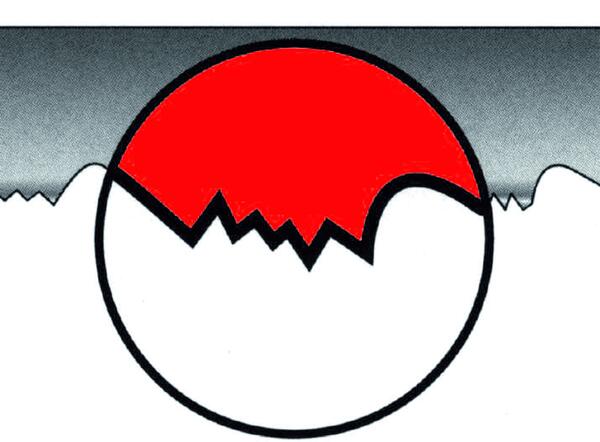
Teeth can also break off if a new blade has not been run in, if the coolant flow is too low, if the chip brush is not working, or if the cut starts on a sharp edge of the workpiece.
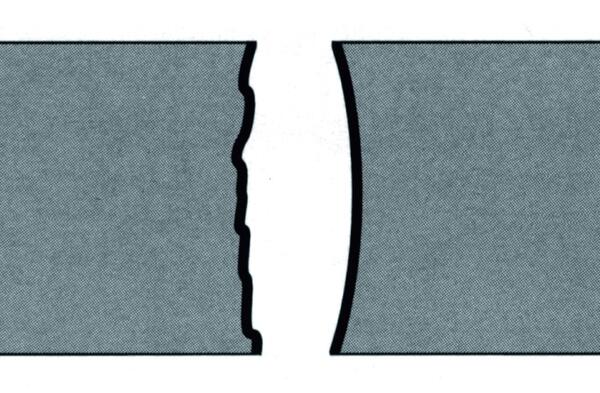
Teeth damaged on one side only will also pull the cut sideways. In that case, replace the blade and check the side guides.
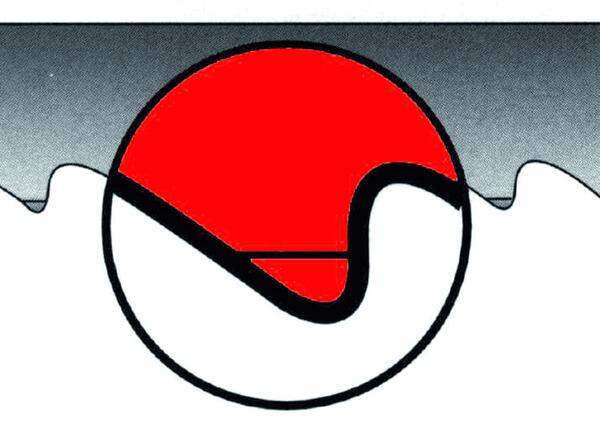
A blade fitted the wrong way round goes dull straight away. The teeth must point in the direction the blade travels, into the material.
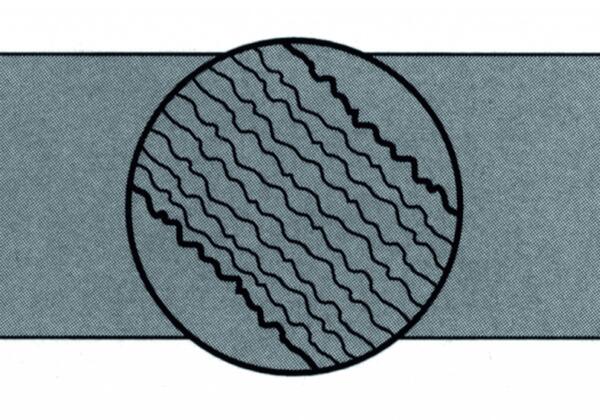
A blade that is not tensioned enough, or guide arms set far from the workpiece, will also leave a rough cut.
Reader questions
First check the guides: neither the side nor the back-up guides may pinch the blade. Then check the tension. On solid material, too fine a pitch can also be the problem: chips pack the gullets and the teeth take blows. On a small saw, a thinner 0.5 mm blade can also help.
It can be, but check the back edge first. If it is peened and sharp, the guides or the wheel flange are pressing on it. Lay the cracked blade on a flat surface: if the ends lift, it was over-tensioned or it is too thick for the saw's wheels. In that case, try a thinner blade.
Check that the wheels are in line once the blade is tensioned and are not tilted, for example because of a bent shaft or a badly seated wheel. A bent guide can also twist the blade. More details earlier in the article.
If it keeps happening with blades of different brands, the cause usually lies in the saw, its set-up or the way you cut. Check the guides, tension, feed pressure and pitch and blade thickness.
Didn't find your problem? Ask in the discussion below the article or email info@dudrsaw.eu. We will be glad to help.

Good day, thank you very much for your very detailed description of the problem.
Based on the damage pattern you described, we consider fundamentally poor quality of the Bandsägeblätter to be rather unlikely. In particular, the fact that the same problem repeats with bands from different manufacturers and that the last twelve bands did not tear at the weld, but the cracks always originated from the tooth side, points more to the cutting conditions or mechanical stress on the band by the machine.
We would check the following points in particular:
Tooth pitch / TPI: Your description lacks information on which tooth pitch you are using. If you use a very fine tooth pitch such as TPI 10/14 or 14/18, it can lead to filling of the gullets with chips, especially when sawing solid material. The tooth can then no longer effectively remove the chips, which can cause high impact loads and stresses in the area of the gullets during the next engagement. Cracks can subsequently originate from there.
A similar problem can also occur when sawing profiles, especially when cutting through the lower profile wall, if too many teeth are in engagement at the same time. As a guide, we recommend a tooth pitch where approximately 10 teeth are in the cut at the same time.
Band tension: Excessive band tension significantly increases the cyclical load on the Bandsägeblatt during each revolution over the wheels and can lead to fatigue cracks. With an already torn band, flatness can also be roughly checked. If the band lies freely on a flat surface and does not remain flat, twists significantly, or the ends stick out of the plane, this may indicate deformation of the band during operation. A possible cause is too high band tension, however, incorrect band guidance or faulty band run are also possible.
Alignment and condition of the wheels: Both wheels should be correctly aligned with each other, and the band should not be constantly corrected laterally during operation. Damaged or uneven running surfaces, play in the bearings, or an incorrect position of the band on the wheels can cause additional cyclical loads.
Band guidance: The side guide elements must not clamp the band too tightly. We also recommend checking the band body itself. If there are clear longitudinal grooves, shiny friction surfaces, or other contact marks on the sides, the guide elements may be worn, damaged, or set too tight. Damaged or over-tightened guides can contribute to the formation of micro-cracks and subsequent band breakage.
Twisting of the band: With such a short saw band, it is also important how much the band has to be twisted from leaving the wheel to the cutting position. If this happens over a very short distance, additional recurring stress is created on the band body. For a band with 13 x 0.65 mm, this stress on a small machine can be quite significant.
For this reason, we would recommend trying a thinner Bandsägeblatt with a band thickness of 0.50 mm for this machine. This can be bent more easily over small wheels and also handles the twisting between the wheel and band guide better.
Specifically, we would recommend the following band: EPIC GP 1140 x 13 x 0.50 mm – TPI 8/12
With a band thickness of 0.50 mm, we unfortunately cannot offer a coarser tooth pitch. TPI 8/12 is suitable, for example, for solid material up to a diameter of about 30 mm. For solid material with a diameter of about 50 mm, a coarser tooth pitch, for example TPI 6/10, would be better suited. However, this is only available with thicker saw bands.
We wish you much success. Best regards, Your Dudr Saw Team
Good morning, thank you for your question. Unfortunately, we don't encounter this very often. I can only think that it might be because the wheels are not aligned (in axis) after tensioning the saw band or are slightly backwards, or some wheel has a wobble or is vertically at a different angle (e.g. due to a bent shaft or poor wheel seating). Or poor guidance in the guides, which overloads the saw band (they are warped). Thank you, regards Pavel Dudr
Good day, 150mm wheels are not necessarily very small for a metal bandsaw. If you have a band speed of 60-90 meters per minute, there won't be that many bends on the wheels. Also check if the band is not starting to break from the back side of the band. Usually, the back edge of the band is sharp - pressed by the guides or by the wheel hubs. Make sure that when the saw is turned off, you have a gap between the rear guides and the band of at least 0.5 - 1 mm, and the same from the wheel hubs. Or when you put paper between the band and the wheel, so that the paper passes through and is not torn between the band and the hub. Then, when you put the torn band on the ground, the ends of the band should remain on the ground. If they lift up (the band is stretched), it might be due to too much band tension or possibly the small wheels.
Good luck, Regards Pavel Dudr