


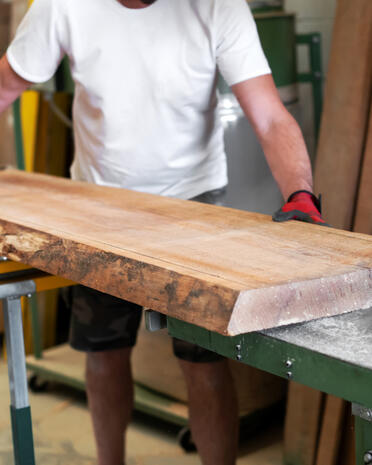
Bandsaw blade terminology: terms, other names and abbreviations
2
Full article
You can build a bandsaw mill yourself. What matters most is the wheel diameter, the blade speed and tension, and good wheel covers. Drawing on our customers' experience, we show what a homemade sawmill is made of, what sizes to choose and which bandsaw blade to fit.

Overview
If you only saw timber a few days a year, you don't need to buy a machine costing thousands or even tens of thousands of euros. Many of our customers have built their own bandsaw mill. From their experience and what we know about bandsaw blades, we have put together what to keep in mind when building one. You will find photos of their mills below.
Jump to:
Construction
On every revolution the blade bends twice over the wheels and straightens out twice. In an hour of work that adds up to tens of thousands of bends. The smaller the wheels, the more sharply the blade bends and the sooner it cracks.
The wheel diameter should be at least 500 times the blade thickness. That is the lower limit: for a 0.9 mm blade, wheels of at least 450 mm, and our customers have had good results with 550 mm. For wheels smaller than 610 mm, blade manufacturers recommend 0.9 mm at most, so 1.1 and 1.3 mm blades belong on larger wheels.
| Blade thickness | Minimum wheel diameter |
|---|---|
| 0.9 mm | 450 mm |
| 1.1 mm | 610 mm |
| 1.3 mm | 650 mm |
Bandsaw mills cut at 20–35 m/s. Soft wood can take a higher speed, hard wood a lower one. The motor must be powerful enough that the blade does not slow down noticeably in the cut. Our customers fit their DIY mills with a motor of around 5 kW.
| Wood | m/s | m/min |
|---|---|---|
| Soft (spruce, pine, poplar) | 25–35 | 1,500–2,100 |
| Hard (oak, beech, black locust) | 20–30 | 1,200–1,800 |
| All-round setting | 25–30 | 1,500–1,800 |
Blade speed depends on the wheel diameter and the wheel rpm: wheel revolutions per minute = blade speed (m/s) × 60 ÷ (3.14 × wheel diameter in metres). The ratio of the pulley diameters is then motor rpm ÷ wheel rpm.
More on cutting speed in the article Bandsaw setup for wood.
Setup
A sawmill blade is tensioned to a stress of roughly 200 N/mm², and RipperS blades to 170–210 N/mm². The cross-section is calculated from the blade width without the tooth height.
Under-tensioned blade
Over-tensioned blade
Without a gauge (rough guide): with the machine switched off, the blade should deflect no more than 3 mm sideways under finger pressure, and it must not wander in the cut. If a blade cracks, lay it on a flat floor with its outer face down: if the ends lift by more than 10 mm, it was over-tensioned. A tension gauge gives the most accurate reading.
We describe how to judge and measure the tension in the article How to tension a bandsaw blade for wood.
The guides keep the blade flat close to the cut. What mainly keeps the blade from running off the wheels is the correct wheel tilt and tension; the guides are a safeguard. On DIY mills they are usually flanged rollers or side rollers with a thrust bearing at the back.
You will find a detailed procedure for setting the wheels and guides in the article Bandsaw setup for wood.
Cable lift
Threaded rod lift
Add a toothed wheel to the crank to give a fixed step, for example 1 tooth = 1 mm up or down. A measuring scale shows the height. Add the blade kerf to the board thickness, about 2–3 mm with RipperS. A pawl holds the saw at the set height; vibration must not let it creep down by itself. Before you do anything under the saw, prop it up – do not rely on the pawl and the cables alone.
Bandsaw blade
Blade thickness is determined by the wheels: for wheels of around 550 mm, choose a 0.9 mm blade, and a 1.1 mm blade only for wheels of 610 mm and above (table in the Wheels section). In the article Sawmill blades: how to choose the width, thickness and tooth type, we describe how to choose the width and tooth to suit the wood, what kerf the blade makes and which blades can be resharpened.
You can work out the approximate blade length from the saw's dimensions: length = 2 × wheel centre distance + 3.14 × wheel diameter (both wheels the same size). Measure the diameter where the blade sits on the wheel; on a wheel with a tyre, measure over the tyre. The centre distance changes as you tension the blade, so calculate with the tensioning wheel in the middle of its travel. Finally, check the length on the finished saw.
Safety
The blade can come off the wheel, or crack and fly out. That is why you should cover the wheels:
In practice
For a 0.9 mm blade, wheels of at least 450 mm, ideally 550 mm. A 1.1 mm blade needs wheels of at least 610 mm, a 1.3 mm blade at least 650 mm. On small wheels the blade bends more sharply and cracks.
Bandsaw mills cut at 20–35 m/s, most often 25–30 m/s. Soft wood can take more, hard wood less. We show how to work out the speed in the section Drive and blade speed.
Gearing does not increase the motor's power, it only changes the speed and the torque. The blade has to run at 20–35 m/s even in the cut. With a weak motor it slows down or stops in a hard or wide log. That is why our customers fit motors of around 5 kW.
With the machine switched off, the blade should deflect no more than 3 mm sideways under finger pressure, and it must not wander in the cut. If a cracked blade lifts its ends by more than 10 mm on a flat floor, it was over-tensioned. More in the article How to tension a bandsaw blade for wood.
Roughly 2 × wheel centre distance + 3.14 × wheel diameter, with the tensioning wheel in the middle of its travel. Check the length on the saw – we weld the blade to the length you need. Calculating the length
Most often because of small wheels, over-tensioning or a rear bearing that touches the blade even when running idle. You will find the causes, sorted by where the blade cracked, in the article Why do bandsaw blades for wood break.
Have you built a bandsaw mill of your own? Share your experience in the discussion below the article. We are also happy to answer your questions at info@dudrsaw.eu.

Dear Mr. Prendin, thank you for your inquiry. If the flywheel width is indeed 140 mm and the diameter is 1300 mm, this is a large sawmill. For machines of this type, bandsaw blades with a width of about 160 mm and a thickness of 1.3 mm are typically used.
Unfortunately, we do not produce such wide blades. For this type of product, I recommend contacting our sister company Dudr Tools s.r.o., which specializes in this segment. You can find more information on their website: www.dudr.cz
Thank you for your understanding, and best regards.
Pavel Dudr
Hello, thank you for your question. The cross-sectional area of the saw blade will be slightly smaller, as the tooth height of approximately 5 mm needs to be subtracted from the width. For a home environment, we recommend tensioning the saw blade so that it does not float in the cut. And then, if you lay a torn blade on the floor and the ends of the saw blade lift up, it means it was tensioned too much.
Sincerely, Pavel Dudr
Good day, companies Řetězy Olomouc or TYMA offer something like this.
In general, as an alternative, I would look for either flat pulleys or wheels from old agricultural machinery.
Good day, I assume it is a saw for textiles with three wheels. If you can set the belt speed to about 900 meters per minute, then probably yes. Then it probably depends on the rigidity of the saw, after all, you need more rigidity for wood than for textiles, as well as e.g. the wear of some parts such as the support guides. Sawdust will probably remain in the machine if there is no extraction, so count on it. I also wonder if the wheels are classic aluminum with a rubber band, hopefully not e.g. plastic, so as not to damage them. Don't forget, if so, to choose a belt thickness of only 0.6 mm if the wheels are e.g. only 300 mm in diameter (belt thickness = wheel diameter / 500). If the band saw has 3 driven wheels, the saw blade bends and straightens on the wheels 3 times per cycle, and therefore a thicker blade may crack.
Good luck with your experiments ;-), regards Pavel Dudr
Good day, thank you for your inquiry. You will lose power through gearing, and you need a saw band speed of at least 15 m/s, and the saw band must not stop while cutting. However, it is true that perhaps the smallest log band saw Holzmann BBS350 has a 2.2 kW motor, it only has a speed of 14 m/s. However, this saw has a saw band size of only 19x0.9 mm, and with this width, you cannot achieve a larger tooth pitch than 2 teeth per inch, so you can only cut very small logs. I would recommend considering a saw band of at least 32x0.9 width, where the standard pitch for logs of 1.1 TPI (pitch approx. 22mm) is also available. And if you look on the internet, for example, with log band saws of the brand LUMAG, the power is selected from 4 to 7.5 kW.
I hope I have helped you a little, we are not involved in the production of machines... Thank you, good luck. Regards Pavel Dudr
Good day, we have an article about it https://www.dudrsaw.eu/technical-articles-and-advice/how-to-tension-a-band-saw-blade-for-metal
In general, however, the blade needs to be tensioned "firmly", but still be able to be moved slightly by 2-3 mm.
Good day, thank you for your correct remark. Regarding the covers, you are right, we forgot to mention it in the article (we will try to fix it).
I discussed the covers with the gentleman who made the green saw in the photo. He said that his cover is sufficient and suitable for him. Of course, he approaches the machine with respect, and no one else moves around the saw. He described his experience that a broken belt always flies in the same direction as the driven wheel. It is also important that the cover is bent downwards in the upper part near the drive wheel, so that the belt does not fly outwards, but downwards towards the ground. If I may say so, the saw blade gets stuck in the wood. And when the belt accidentally falls off the wheels (slips), it gets caught in the upper cover (precisely for this reason, the cover reaches low enough).
Besides, the gentleman has a rule that no one stands or walks next to the saw while it is cutting. If he is removing cut boards, he has the saw in front of him and removes the boards from behind. If he has an assistant, he cuts the wood in front of the saw, but only when the saw is sufficiently far back (as seen in the photos – his saw moves on "rails"). He also mentioned that the belt slipped off while he was adjusting it and broke while he was cutting. However, it has never happened to him that the belt broke or slipped off the wheels when the saw is stationary and running idle.
Some people have all the wheels and the belt covered, but this is not common. In any case, safety always comes first – one must approach such a machine with respect again and again...
Yes, we deliver saw blades custom-welded and sharpened for soft (SOFT) or hard (HARD) wood. Please order in advance – it takes longer because we sharpen and set the blades only after custom welding. Please send us a photo of your saw, how you have solved its construction and covering (email info@simonds.cz). We will be happy to publish the photos (for others too), so people have inspiration ;-).
Thank you, good luck.
Sincerely,
Pavel Dudr