


VIDEO: How to determine the length of a band saw blade?
2
Full article
Bandsaw blade, band saw blade or saw band: one tool goes by several names, and blade descriptions add abbreviations such as TPI, HSS or M42. This glossary gives you the key terms, their other names and links to detailed guides.
Glossary
For each term you will find the main name, then other names you may hear in the workshop or see from other sellers, and a short explanation. Where it helps, we link to a detailed guide or straight to the blades in our shop.
saw band
= Bandsaw blade
A steel band with teeth along one edge, welded into a closed loop.
TPI
= Tooth pitch
The distance between the tips of neighbouring teeth (p). On bandsaw blades it is given in TPI, teeth per inch (25.4 mm).
tungsten carbide
= Carbide
Small pieces of sintered tungsten carbide are welded onto the tooth tips and ground to shape.
Jump to a term:
Names
Two terms that are often mixed up: the bandsaw is the machine, and the bandsaw blade is the tool that is fitted to it and does the cutting.
Also called
band saw blade, saw band, band
German Bandsägeblatt
A steel band with teeth along one edge, welded into a closed loop. On the saw it runs over the wheels, so the teeth always cut in the same direction. Blades for wood are usually made of carbon steel, blades for metal of spring steel with high-speed steel teeth (bi-metal).
In the shop: Band saw blades for wood · Band saw blades for metal · Band saw blades for meat · Band saw blades for bricks
Also called
band saw
German Bandsäge
A machine with two, or occasionally three, wheels that the bandsaw blade runs over. One wheel is driven by the motor. Depending on what they are built for, there are bandsaws for wood, for metal, for meat and bone, and for building materials.

Blade parts
The drawing shows the blade from the side and from the front. The numbers and letters in it match the terms below.
The tooth removes the material. The tip (1) does the cutting, the face (2) is the front surface of the tooth that the chip slides off, and the back (3) is the rear surface. On the saw, the teeth at the cutting point must point in the direction the blade travels, into the material; on a vertical saw that means down, towards the table.
Also called
rake, hook angle (on wood blades)
The rake angle is the slope of the tooth face. Regular and Skip teeth have a zero rake angle; a tooth with a positive rake bites harder into the material (the Hook shape on wood blades). The back angle affects the strength of the tooth and the size of the gullet: a smaller angle gives a sturdier tooth, a larger one more room for chips.
The space between the teeth (4). Sawdust or chips collect in it and drop out once the tooth leaves the material. If the gullet is too small for the cut, it clogs, and the blade cuts slowly and heats up.
Also called
pitch, teeth per inch
German ZpZ
The distance between the tips of neighbouring teeth (p). On bandsaw blades it is given in TPI, teeth per inch (25.4 mm). The higher the number, the smaller and closer the teeth: 4 TPI is about 6 mm from tip to tip, 10 TPI about 2.5 mm. 10/14 means a variable pitch (vari-pitch): the pitch varies between 10 and 14 TPI along the blade, which dampens vibration. It is used mainly on blades for metal.
More: Choosing tooth pitch for a band saw blade for wood · How to choose a bandsaw blade for metal
Also called
raker set (on metal blades)
The teeth are bent alternately to the left and right, so the blade cuts a slot wider than its body and does not bind in the cut. On blades for metal, there is often also a straight tooth (the raker) between the set teeth. Teeth are set with saw set pliers or a setting machine; new blades come set from the factory.
The width of the slot the blade cuts (k). It comes from the set; in practice it is about 0.2 mm wider, because the blade vibrates in the cut. A wider set is chosen for material that pinches the blade in the cut (open sections, for example), a narrower one where a clean cut matters.
Also called
thickness = gauge
Width (w) is measured from the tooth tip to the back edge. Thickness (t) is that of the steel strip the blade is made from; it is chosen to suit the blade width and the diameter of the saw's wheels, and small wheels need a thinner blade. Length is the circumference of the welded blade and is set by the saw.
More: Which bandsaw blade width should you choose for wood? · How to determine the length of a band saw blade?
Also called
blade back (not to be confused with the tooth back)
The edge without teeth (5). It bears against the saw's back-up guide. If the guide or the wheel flange presses on it all the time, the edge gets peened and the blade can crack from there.
Teeth, materials
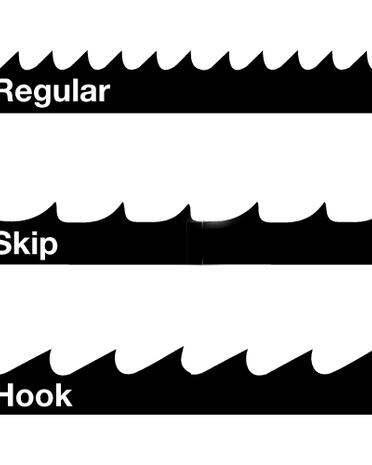
On blades for wood, the tooth shape is marked with one of three names: Regular, Skip or Hook. It tells you what kind of cut the blade is made for.
Also called
regular tooth
Zero rake angle and a smaller gullet. The smoothest, cleanest cut; an all-round choice, including for thin material.
Also called
skip tooth
Zero rake angle, and it is as if every other tooth were missing: the teeth are spaced further apart and the gullet is large. Clears sawdust well; suits soft and wet wood and rougher cutting.
Also called
hook tooth
Positive rake angle of about 10° and a large gullet. The tooth pulls itself into the material and cuts fast. Suits hardwood and larger diameters.
More: Tooth shape - band saw blade for wood
Also called
carbon blade, flexback
A carbon steel blade with hardened tooth tips and a flexible body. The most common blade for wood and the cheapest option; ours is the Carbon Flexback series.
Also called
bimetal, M42 blade
A spring steel body with a strip of high-speed steel (HSS) welded on, from which the teeth are ground. The teeth are hard, around 67–69 HRC, while the body stays flexible. The standard for cutting metal. M42 is the most common HSS grade, with 8% cobalt; M51 has more cobalt and tungsten and resists wear better.
In the shop: Band saw blades for metal · Materials of band saw blades for metal
Also called
carbide-tipped, TCT, carbide teeth
Small pieces of sintered tungsten carbide are welded onto the tooth tips and ground to shape. Cuts hard, abrasive and otherwise difficult materials and leaves a clean cut. More expensive and more sensitive to knocks and impacts.
More: Carbide Wood · Hardened, unhardened and carbide teeth: what is the difference?
Also called
stellite
The hard alloy stellite is welded onto the tooth tips. These blades are used on sawmill bandsaws for cutting logs.
Rockwell C hardness scale. The higher the number, the harder the tooth. High-speed steel teeth are around 67–69 HRC. Carbide hardness is given on a different scale (HRA).
Markings
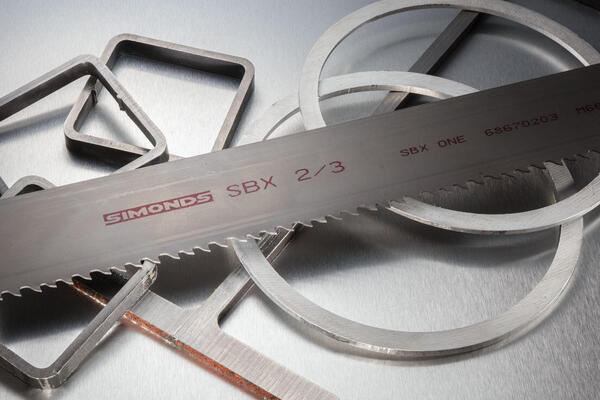
On blades for wood, the tooth shape is given instead of the steel grade, for example 1400 × 10 × 0.65 mm · 6 TPI Regular. The series name is usually printed on the blade as well, such as EPIC GP or SBX.
More: Product label: what do the figures on a band saw blade mean?
Weld
The blade is cut to the exact length and the ends are butt-welded by resistance welding, without filler metal. The weld is then ground and annealed so that it is not brittle. A good weld is straight and smooth, and the blade does not jump on it in the cut.
Themed photos
Saw and cutting
Also called
upper and lower wheels, drive wheel
The blade runs over the wheels, and one of them is driven by the motor. The wheel diameter determines how thin a blade the saw needs. On woodworking saws, the wheels usually have rubber tyres.
Also called
roller guides, guide bearings, side and back-up guides (thrust bearing)
They keep the blade straight in the cut. The side guides support it from both sides, and the back-up guide supports the back edge. They can be bearing, carbide or ceramic guides.
Also called
blade tension, tensioning
How tightly the blade is stretched between the wheels. It is given as stress in N/mm², i.e. the pulling force per square millimetre of the blade's cross-section, and measured with a tension gauge. Depending on the blade type and width, it ranges from about 100 to 300 N/mm².
More: How to tension a bandsaw blade for wood? · How to tension a band saw blade for metal
Also called
swarf brush
On metal-cutting saws, it cleans chips out of the gullets so that they are not carried back into the cut.
Also called
soluble oil
The fluid that cools and lubricates the teeth and flushes away chips when cutting metal. Most often an oil-in-water emulsion.
Also called
band speed
How fast the blade runs round, in metres per minute (m/min). For metal it depends on the material being cut: the harder the material, the lower the speed.
Also called
feed rate
How fast the blade advances through the material and how hard it presses on it. Too much feed pressure breaks teeth and cracks the blade; too little lets the teeth just rub over the material, and they go dull faster.
How many teeth are in the material at the same time. The pitch is chosen according to this number: for metal ideally about 12 (at least 4, no more than 24), for wood 2 to 8.
Also called
break-in
For the first 15–20 minutes with a new blade for metal, cut with about half the usual feed pressure and at a lower speed. This stops the very sharp tips from chipping, and the blade lasts longer.
We weld blades to the length you need. Choose by material, or directly by your saw: Selecting a blade according to your band saw. We also have band saw blades for meat and band saw blades for bricks.
Hello,
A gap or - the size of the tooth opening - in the picture it is the letter k. In the table you will find the cross-section thickness of our most popular bands here.
Thank you, regards Pavel Dudr