


How to cut unconventional or special materials?
Full article
Choose a bandsaw mill blade to suit the saw and the wood. The saw determines the length, the width and the maximum thickness, and you select the tooth type according to whether you cut soft or hard wood. We show how to find the right blade, which sizes customers order most often and how to look after the blade.
Overview
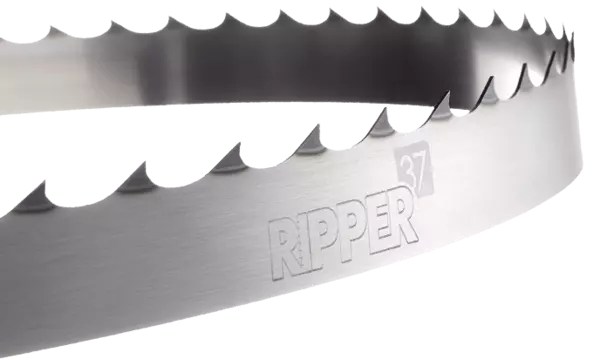
A sawmill blade runs on a bandsaw mill (often called a portable sawmill), which cuts logs lengthwise into boards and beams. It is wider and thicker than a blade for a woodworking bandsaw and has large teeth: one or two per inch of length. Our RipperS PREMIUM sawmill blades cut soft and hard, dry and green wood.
Jump to:
Size
The blade length is determined by the saw's wheels and the distance between them. The safest way is to take it from the saw manual or from the label of a blade the saw cuts well with. The label on our blades gives the size as width × thickness × length.
We describe how to measure the length of an old blade in the article How to determine the length of a bandsaw blade. On a DIY mill you can work it out roughly using the article DIY bandsaw mill.
The width is determined by the saw's wheels and guides. We make RipperS PREMIUM sawmill blades in widths of 27, 32, 34, 35 and 38 mm. Stick to the width given by the saw manufacturer or the width of a blade with which the saw cuts straight. We do not offer the wider blades used on large bandsaws in industrial sawmills.
On every revolution the blade bends twice around the wheels. A thicker blade is stiffer and more stable in the cut, but it cracks sooner on small wheels. For wheels smaller than 610 mm we recommend 0.9 mm at most. So choose the thickness according to the wheel diameter:
| Blade thickness | Minimum wheel diameter | RipperS PREMIUM widths |
|---|---|---|
| 0.9 mm | 450 mm | 27, 34, 35 mm |
| 1.1 mm | 610 mm | 32, 34, 35, 38 mm |
| 1.3 mm | 650 mm | 38 mm |
For a 0.9 mm blade, our customers have had good results with wheels of around 550 mm. Larger wheels put less strain on the blade and extend its life.
Teeth
Blades 32–38 mm wide have a pitch of 1.1 TPI, i.e. roughly one tooth per inch (22 mm). They differ in how far the teeth are bent out to the sides (the tooth set):
Do you cut both? You can use a HARD blade on soft wood too.
The narrower the tooth set, the narrower the kerf and the more of the log ends up in the boards. The tooth set of our sawmill blades:
| Width × thickness (mm) | Tooth | Set (mm) |
|---|---|---|
| 27 × 0.9 | 2 Hook | 1.9 |
| 34 × 0.9 · 35 × 0.9 | 1.1 HARD / SOFT | 2.0 / 2.3 |
| 32 × 1.1 · 34 × 1.1 · 35 × 1.1 · 38 × 1.1 | 1.1 HARD / SOFT | 2.2 / 2.5 |
| 38 × 1.3 | 1.1 HARD / SOFT | 2.4 / 2.7 |
The actual kerf is about 0.2 mm wider than the set, because the blade vibrates slightly in the cut.
A hardened carbon steel blade is the standard choice. Bi-metal is for heavier use: when you cut large volumes and want to change blades less often.
RipperS PREMIUM
RipperS BIMETAL PREMIUM
These are the sizes that customers in the Czech Republic and Slovakia ordered from us most often over the last 12 months. The link next to each type takes you straight to the blade in our online shop. Always check the length on your own saw.
In use
A sawmill blade is tensioned more than a woodworking blade. Tension RipperS blades to 170–210 N/mm² of cross-section, in practice to around 200 N/mm². We describe how to measure the tension and how to judge it without a gauge in the article How to tension a bandsaw blade for wood.
You will find step-by-step wheel and guide setup in the article Bandsaw setup for wood, and the causes of cracked blades in the article Why do bandsaw blades for wood break.
In our experience, a hardened RipperS PREMIUM blade cuts roughly 2–3 m³ of logs, and a bi-metal blade several times as much. Experienced sawyers cut as much as 10 m³ with bi-metal. A lot depends on the wood: dirt and small stones in the bark blunt the blade quickly.
RipperS blades 32 mm wide and above can be resharpened and reset repeatedly. The 27 mm blade with the 2 Hook tooth cannot be resharpened. If you are not sure how to go about sharpening, write to us or give us a call and we will advise you. You will find our details on the Contacts page.
Weld warranty: if a sawmill blade cracks at the weld, we will replace it with a new one. How the warranty works
We make sawmill blades to order: we weld them to your length, sharpen them and deburr them. So order them in good time, ideally before your current blade reaches the end of its life.
In practice
By wheel diameter: 0.9 mm for wheels from 450 mm, 1.1 mm from 610 mm, 1.3 mm from 650 mm. Table
Yes. HARD has a narrower tooth set and a narrower kerf, and it cuts soft wood as well. If you mainly cut soft wood, go for SOFT.
No, a sawmill blade belongs on a bandsaw mill. For a woodworking bandsaw, choose a narrower blade, such as Carbon Flexback.
A hardened RipperS PREMIUM blade cuts roughly 2–3 m³, and a bi-metal blade several times as much. It depends on the wood and on whether there is dirt or small stones in the bark.
Yes, RipperS blades 32 mm wide and above can be resharpened and reset repeatedly. The 27 mm blade with the 2 Hook tooth cannot be resharpened.
In the saw manual or on the label of the old blade. The article How to determine the length of a bandsaw blade shows how to measure it.
Not sure which blade to choose? In the discussion below the article, tell us your saw model, the diameter of its wheels and the wood you cut. We will advise you on the blade size and tooth type.

